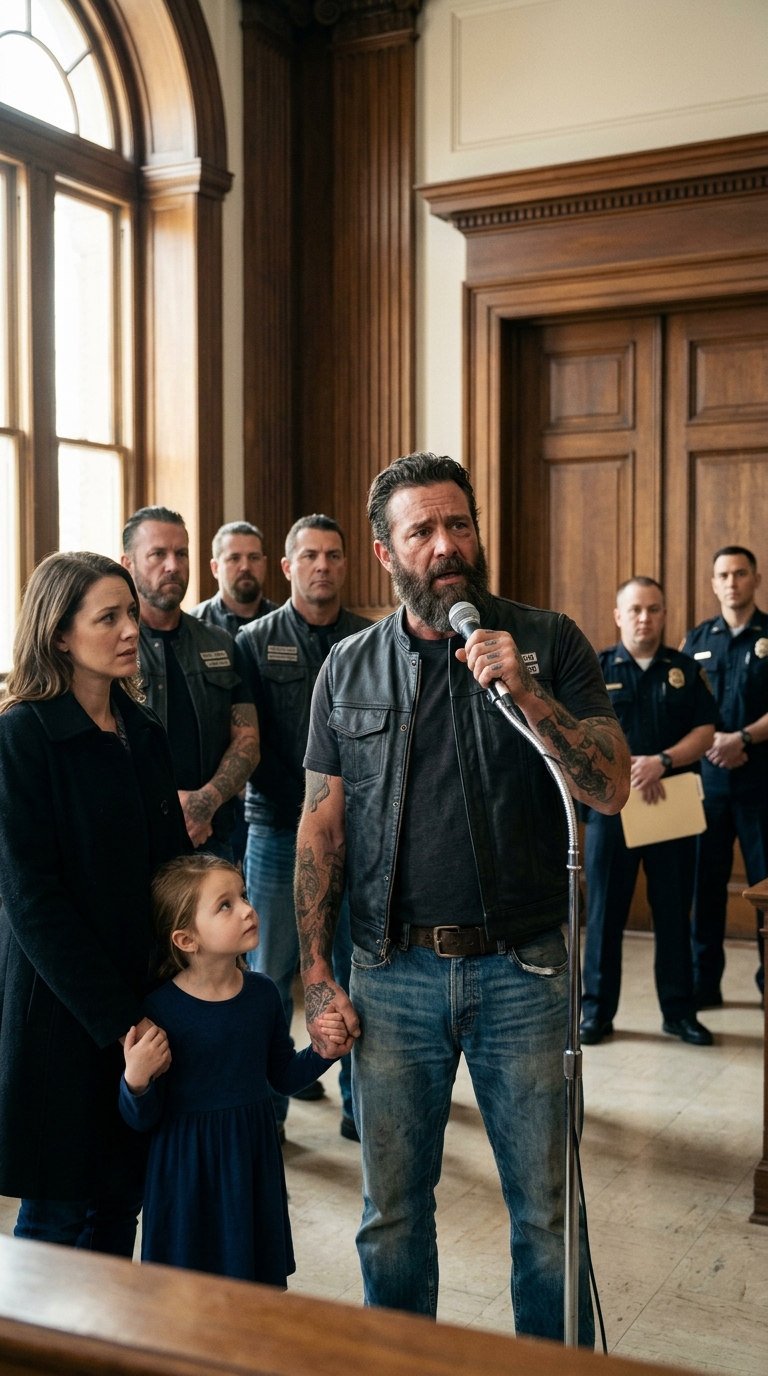

PART 1 — THE THING AVA THOUGHT COURAGE LOOKED LIKE
The eight-year-old girl was hiding beneath her foster mother’s kitchen table when she whispered, “I can tell the truth—but only if thirty big people stand between me and him.”
Nobody laughed.
My name is Natalie Brooks, and I was the child-victim advocate assigned to help Ava Thompson prepare for testimony. I had worked with frightened children before. Some wanted stuffed animals. Some wanted headphones. Some wanted closed-circuit testimony or therapy dogs.
Ava wanted thirty bikers.
Ava was eight years old but carried herself like someone who expected interruptions. She spoke softly. Counted exits. Folded sleeves over her hands even in warm rooms. Whenever a door opened unexpectedly, she looked first and listened second.
She had already survived the hardest part.
Now adults needed her to explain it.
The court had approved accommodations. Break cards. Short testimony windows. Separate waiting rooms. But one rule couldn’t change.
The defendant would be present.
When Ava learned that, she disappeared beneath the kitchen table.
Her foster mother Melissa sat nearby.
“What would help?” she asked.
Ava answered immediately.
“People.”
“How many?”
She thought.
“Thirty.”
Then quietly—
“My bikers.”
For three months, a local motorcycle support chapter had become part of her world. They never asked her questions she didn’t want. They sat outside counseling appointments. Sent birthday cards. Showed up at school concerts. They treated her like somebody whose life continued instead of somebody whose life had paused.
Their biggest rider was Atlas.
Fifty-nine. Huge shoulders. Silver beard. Hands that looked built for engines.
Ava once asked if he had ever been scary.
Atlas answered—
“Every day.”
She looked surprised.
He smiled.
“Then I learned scary and dangerous aren’t the same thing.”
She never forgot.
The group gave Ava a child-sized denim vest.
Road name: FIREFLY.
Because she said—
“I’m little but I still make light.”
When Atlas heard her request, he didn’t promise.
He asked questions.
Then he called lawyers.
Court staff.
Security.
The prosecutor.
Every rider agreed immediately to every condition.
No interaction with the defendant.
No displays.
No intimidation.
No speeches.
Only presence.
The night before testimony, Atlas visited Ava’s foster home.
He stayed outside.
Ava came onto the porch.
He handed her a folded sheet.
Thirty names.
Thirty signatures.
At the bottom he had written:
WE SHOW UP.
Ava read every name.
Then asked—
“What if I still get scared?”
Atlas looked at her.
“Then we’ll be there while you do it.”
The next morning she wore a navy dress and shoes too shiny for courthouse hallways.
She made it through security.
Then she saw the defendant through courtroom glass.
Her breathing changed instantly.
She backed against the wall.
“He knows I’m here.”
I knelt beside her.
“He cannot come near you.”
She shook her head.
“That doesn’t stop him being big.”
Then the elevator opened.
Thirty bikers stepped out.
No noise.
No drama.
Just leather vests and calm faces.
Atlas removed his sunglasses.
“Morning, Firefly.”
Ava whispered—
“You really came.”
He smiled.
“All thirty.” Read the full story below the link in the comments.
PART 2 — THE THING SHE SAID OUT LOUD
The judge approved seating.
Two rows.
Directly in Ava’s line of sight.
The riders entered quietly and sat.
No crossed arms.
No staring.
No performance.
When Ava walked into the courtroom, the defendant turned immediately.
Atlas moved one inch.
Scout moved too.
Then thirty riders adjusted naturally until their shoulders blocked Ava’s direct line of sight.
No rules broken.
No words spoken.
Just a wall of ordinary people choosing where to sit.
Ava climbed into the witness chair.
The prosecutor asked her name.
She froze.
Hands hidden in sleeves.
Eyes fixed on Atlas.
He didn’t nod.
Didn’t gesture.
He simply placed one hand over his heart.
Scout did the same.
Then another rider.
Then all thirty.
Ava breathed.
“My name is Ava.”
Questions began.
Simple first.
School.
Favorite color.
Safe things.
Then harder.
She paused often.
Used the yellow break card once.
But she kept going.
The courtroom stayed silent.
Halfway through testimony the defense attorney changed strategy.
His voice softened.
He asked—
“Ava, are you sure you remember correctly?”
Ava became smaller instantly.
I felt it happen.
He continued—
“Sometimes children misunderstand grown-ups.”
Ava looked down.
Then toward the bikers.
Atlas wasn’t looking angry.
He was listening.
She stared at thirty enormous adults sitting completely still.
Nobody rescuing her.
Nobody speaking for her.
Waiting.
Then Ava looked back.
And asked a question nobody expected.
“If I tell the truth and you don’t like it… does it become not true?”
Silence.
The attorney stopped.
The judge looked up.
Ava continued.
Voice shaking.
“You’re asking like I’m in trouble.”
Nobody moved.
She swallowed.
Then said—
“I already did the scary part.”
Her testimony continued.
Clear.
Short.
Enough.
When she finished, the courtroom took a recess.
As Ava stepped down, the judge quietly asked Atlas to approach.
People got nervous.
Atlas walked carefully.
The judge looked at the riders.
Then asked—
“Why thirty?”
Atlas glanced toward Ava.
Then answered—
“Because she thought courage looked like being unafraid.”
He looked around the room.
“We came to show her courage can look terrified and still walk forward.”
Nobody spoke.
PART 3 — THE SPOT SHE SAVED
Three weeks later the decision came.
The defendant was convicted.
Not because of emotion.
Not because of motorcycles.
Because evidence matched.
Because testimony mattered.
Because Ava spoke.
That afternoon Melissa took Ava for ice cream.
Atlas and several riders happened to arrive too.
Completely by accident.
Nobody believed that.
Ava sat quietly.
Then suddenly asked—
“Now what?”
Atlas blinked.
“What do you mean?”
She shrugged.
“I was busy being brave.”
People laughed.
Then got quiet.
Because children say things adults forget.
Atlas thought.
Then pulled something from his vest.
A cloth patch.
Small.
Yellow.
It said:
NOT ALONE.
Ava looked confused.
Atlas smiled.
“This isn’t for being brave.”
She waited.
He continued.
“It’s for showing up.”
Months passed.
Ava started soccer.
Stopped counting exits.
Started interrupting adults.
Huge progress.
One afternoon I visited her house.
She had built something in the backyard.
Thirty toy motorcycles.
A cardboard courthouse.
One tiny figure standing at the front.
I asked—
“Who’s that?”
She smiled.
“That’s me.”
I pointed at the bikes.
“And them?”
She thought.
Then answered—
“That’s not them.”
I looked confused.
Ava shrugged.
“That’s what it feels like when people stay.”
Years later she gave a school presentation.
At the end someone asked—
“Weren’t you scared?”
Ava smiled.
Then said—
“I thought brave meant being alone.”
She looked down.
Then grinned.
“Turns out I just needed thirty really large emotional support adults.”
The room laughed.
She still keeps the vest.
Still wears the patch.
And inside, stitched under the pocket, Atlas added one line she didn’t discover until much later:
YOU NEVER HAD TO STAND THERE BY YOURSELF.