Part I — The Dress, the Money, and the Lie Everyone Believed
By six-thirty on a Thursday evening, the terrace of Marble Row Café glittered with the kind of polished wealth that made ordinary people lower their voices without knowing why. Crystal glasses flashed in the amber light. Men in tailored suits laughed too loudly about numbers that could move markets. Women in silk leaned back in their chairs as if the city itself belonged to them. It was the favorite after-hours corner for the men of lower Manhattan who liked their bourbon expensive, their scandals hidden, and their power visible from the sidewalk.
That was why Richard Cole loved it.
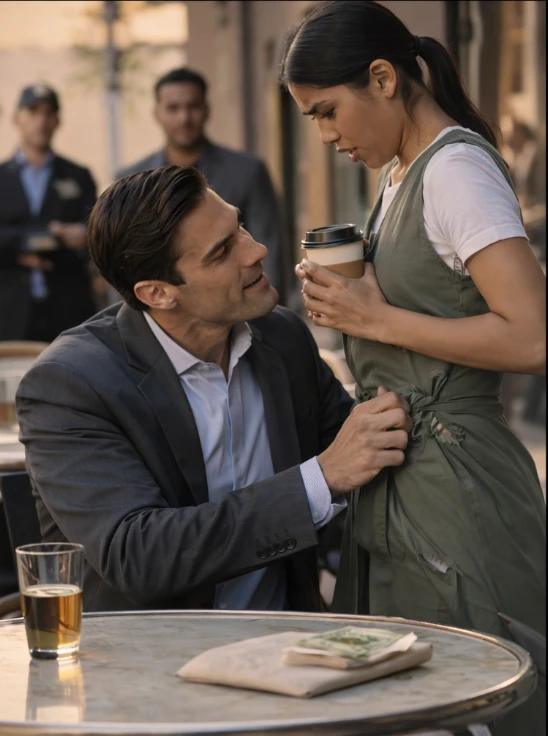
He sat alone at a small round table near the rail, one leg crossed over the other, his navy suit immaculate, his silver watch gleaming every time he lifted his drink. At forty-six, Richard had the sharpened handsomeness of a man who had spent a lifetime polishing himself into a weapon. His dark hair was cut with surgical precision. His jaw looked carved. His smile—when it appeared—never reached his eyes.
People knew him. Not just because he was wealthy, though he was. Not just because he had once made a brutal bet against a collapsing company and walked away with enough money to buy half a block, though that story had made him legendary. People knew him because he enjoyed being watched. Richard Cole didn’t simply enter a room. He occupied it. Claimed it. Bent the air around him until everyone inside was forced to breathe him in.
When Emily Carter stepped onto the terrace carrying a paper coffee cup and a small tray of napkins, she drew almost no attention at all.
She wore a muted green service dress tied at the waist over a white shirt, practical flats, and the exhausted expression of someone working her second shift. Her black hair was pulled into a neat ponytail. She moved quickly, carefully, with the quiet concentration of a woman who had learned that mistakes cost more than pride. She was beautiful, but not in the polished, deliberate way of the women at Richard’s table. There was no performance in her. Only restraint.
Richard noticed that immediately.
“Hey,” he called, lifting two fingers.
Emily turned. “Yes, sir?”
“Come here.”
There was something in his tone she disliked at once. Still, she approached the table with her professional smile, the thin one that never belonged to her real face.
“You forgot my napkin,” he said.
“There’s one on the tray, sir.”
“I meant cloth.”
Emily looked down. A folded linen napkin sat directly beside his glass.
Her eyes flicked back up. “You already have one.”
Richard smiled lazily. “Then maybe I just wanted to see whether you’d argue.”
A few men at the next table chuckled. Emily’s fingers tightened around the coffee cup. She knew the type. Every woman who worked in this city knew the type. Men who made humiliation feel casual. Men who used charm like a knife wrapped in velvet.
“I’m sorry if something isn’t right,” she said. “Would you like me to get your server?”
“No,” Richard replied, looking her over without shame. “I think I’d rather keep you.”
The laughter spread this time.
A flush climbed Emily’s neck, but her voice remained level. “I have other tables.”
Richard leaned back, amused by her resistance. “What’s your name?”
“Emily.”
“Emily.” He repeated it slowly, like he was tasting it. “That’s a sweet name.”
She said nothing.
He nodded toward the cash folded on the table beside the napkin. “Do you know what that is?”
Emily didn’t look. “Money.”
“It’s more money than most people here tip in a month.” His eyes glittered. “And I was thinking maybe you’d earned it.”
“For what?”
“For standing there looking scared.”
The men nearby laughed again, louder now, because once a powerful man begins a performance, weaker men rush to become his audience.
Emily drew a breath. “I’m not scared of you.”
Richard’s smile sharpened. “You should be.”
What happened next was so fast that later, half the people who witnessed it would describe it differently.
Richard reached out as if to adjust the tie at Emily’s waist. Then his hand closed on the fabric of her dress and pulled.
Not enough to drag her forward. Not enough to expose her in a criminal way. But enough to tear the stitching at her side with a sudden ripping sound that cut through the terrace like a scream.
Emily gasped and stumbled back, one hand flying to hold the dress together. Her coffee cup slipped, hit the edge of the table, and splashed across the stone floor.
For one frozen second, silence took the whole terrace.
Then Richard picked up the folded cash and flicked it toward her.
Bills struck her shoulder, fluttered down over the wet stone, and settled at her feet.
“Relax,” he said, smiling up at her. “That’s more than you make in a week.”
Emily stared at him.
Not shocked. Not crying.
Just staring.
Her face had changed.
The humiliation was there, yes. The tremor in her breathing, the flush in her cheeks, the way her arm pressed tightly against the torn seam of her dress. But beneath all of it, something colder had appeared. Something that did not belong to a frightened waitress on a rich man’s terrace.
One of the women at a nearby table whispered, “Oh my God.”
Richard, still smiling, expected anger, maybe tears, maybe a scene he could later dismiss with a check and a lawyer. Instead, Emily lowered her eyes, set the tray down on an empty chair, and reached into the pocket of her apron.
She took out a phone.
Richard laughed softly. “Calling the manager?”
Emily looked at him as if she could suddenly see straight through his skin.
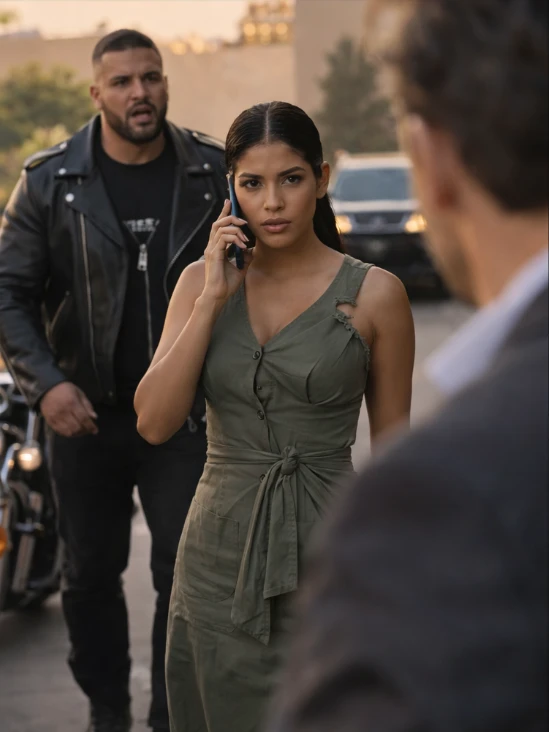
Then she lifted the phone to her ear.
“Who are you calling?” he asked.
She did not answer at first. Her voice, when it came, was quiet and perfectly steady.
“Hi,” she said into the phone. “It’s me.”
A pause.
Then: “I found him.”
The terrace shifted.
Nothing visible. Nothing anyone could name. But the atmosphere changed, as if some invisible current had just reversed direction. Richard felt it without understanding it.
He stood, irritated now. “Put the phone down.”
Emily ignored him.
Her dark eyes remained on his face. “Yes,” she said into the phone. “At Marble Row. He put his hands on me.”
The words landed harder than shouting would have.
Richard took a step toward her. “Listen to me carefully—”
“No, Richard,” she said, and it was the first time she had spoken his name. “You listen to me. You just made the worst mistake of your life.”
The men at the next table stopped smiling.
From the edge of the street came the low, rising growl of engines.
At first it sounded like city traffic.
Then the sound grew louder.
Closer.
Heavier.
Heads turned toward the avenue.
Three black SUVs swung around the corner at speed, tires biting hard against the pavement, followed by two motorcycles that moved with predatory precision. The vehicles stopped so abruptly that one of the women on the terrace dropped her glass.
Richard felt something unfamiliar move through his chest.
Not guilt.
Not shame.
Fear.
The first SUV door opened.
And the nightmare stepped out.
Part II — The Men Who Came, the Name He Knew, and the Blood in the Street
The man who emerged from the lead SUV was enormous.
Not merely tall, though he was. Not simply muscular, though his black leather jacket strained across his shoulders. It was the way he moved that changed everything—the heavy, contained stride of someone utterly certain that violence would obey him if he asked. He had close-cropped dark hair, a trimmed beard, and the dead-eyed focus of a trained predator.
Marcus Reed.
The name hit Richard a second before the recognition fully formed.
He had seen Marcus once before, across a ballroom in the Hamptons, standing near a senator no one approached without permission. He had heard whispers in private clubs and back rooms where rich men lowered their voices. Former Marine. Corporate security genius. Personal fixer to people who did not trust the police, the press, or the law. A man who handled threats by removing them from the board.
Marcus Reed walked straight onto the café terrace.
Two more men in dark jackets followed him. Another remained near the SUV. The motorcycle riders stayed by the curb, engines idling like distant thunder.
Every conversation on the terrace died.
Richard tried to recover his posture, his old command. “This is private property—”
Marcus didn’t even look at him.
He stopped in front of Emily.
His expression changed at once.
It did not soften exactly. Men like Marcus Reed did not soften. But the violence in him folded inward, leashed by something deeper.
“Emily,” he said.
“I’m okay.”
His eyes dropped to the torn seam of her dress, then to the money on the wet stone, then to Richard.
When Marcus finally turned his head, Richard understood why prey animals freeze. It was not because they hoped they might survive. It was because some instincts were older than hope.
Marcus stepped forward and seized Richard by the collar.
The terrace erupted.
A chair crashed backward. Someone shouted. Richard’s glass tipped and shattered. Marcus dragged him halfway across the table with one hand, close enough that Richard could smell leather, rain, and cold fury.
“You touched her?” Marcus asked.
Richard grabbed Marcus’s wrist, trying and failing to pry it loose. “Get your hands off me!”
Marcus’s voice dropped lower. “You don’t touch her. Ever.”
Richard had dealt with angry husbands, screaming clients, men who threatened lawsuits, men who bluffed, men who broke. He knew the choreography of intimidation. But there was no performance in Marcus. No negotiation. This was not a man trying to win. This was a man deciding how much damage he was willing to stop short of.
Emily stepped forward. “Marcus.”
He didn’t release Richard, but his eyes flicked toward her.
“Not here,” she said.
Richard sucked in air and straightened as much as Marcus’s grip allowed. He forced out a laugh, though it came thinner than he intended. “Who the hell do you think you are?”
Marcus let him go.
Richard staggered back, coughing, furious at the sound his body had made.
Then another figure rose from the second SUV.
He was older. Elegant. Silver-haired. Wearing a charcoal overcoat over a dark suit so perfectly tailored it seemed to erase the city’s grime around him. He moved without hurry. That alone was enough to make the terrace feel smaller.
People recognized him slowly, then all at once.
Even Richard.
His mouth went dry.
Charles Carter.
Founder of Carter Meridian Holdings. Billionaire. Deal-maker. Political donor. The man whose signature could rescue a bank or bury a board. Publicly respected, privately feared. The kind of man newspapers described as strategic because they were too polite to call him merciless.
Richard had spent years trying to get into Charles Carter’s circle and failing.
And Emily—quiet, tired, practical Emily in the green service dress—turned when she saw him with a look that was not surprise at all.
It was relief.
Charles came onto the terrace and stopped beside her.
“Did he hurt you?”
Emily shook her head once. “Not enough to matter.”
But Charles’s eyes had already found the torn fabric.
For a terrifying second, Richard thought the older man might shout.
Instead, Charles smiled.
It was a small, civilized smile. The kind that could pass in photographs for kindness.
It was also the coldest expression Richard had ever seen.
“Mr. Cole,” Charles said. “I’ve heard so much about you.”
Richard swallowed. “Mr. Carter, I—I think there’s been some misunderstanding.”
Emily looked away, almost as if she pitied him.
Charles glanced at the cash on the ground. “Did you throw money at my daughter?”
The word daughter moved through the terrace like an electrical surge.
No one spoke.
No one breathed.
Richard felt his mind trip over the reality, refuse it, then slam into it again. Daughter? Emily Carter. Carter. Of course. Of course. The name had been there from the start like a lit match in daylight, and his arrogance had made him blind.
“I didn’t know,” Richard said hoarsely.
Charles tipped his head. “That is the defense you’re choosing?”
Richard looked at Emily. “Why were you working here?”
Emily met his stare with a strange, tired calm. “Because unlike you, I wanted to know how people behave when they think no one important is watching.”
The words struck harder than Marcus’s grip.
Charles slid one hand into his coat pocket. “Emily has spent the last six months moving anonymously through Carter Meridian properties, partner properties, vendor networks, and service environments. Interning under false names. Working ordinary jobs. Watching how the powerful treat the powerless when they believe there will be no consequences.”
Richard blinked. “What?”
“She designed it herself,” Charles said. “A human ethics audit. Quiet. Independent. Unpublished.”
A woman at the next table whispered, “Jesus.”
Emily’s expression did not change. “You were on my list long before tonight.”
That froze him.
“What list?”
Now she did smile, though there was no warmth in it. “The men who use money to buy silence.”
Richard’s skin turned cold. “You set me up.”
“No,” Emily said. “You exposed yourself.”
Charles looked almost pleased by the line.
Richard tried to gather himself, to become the man who always found the hidden exit in a negotiation. “Whatever this is, it can be handled privately.”
Charles laughed softly.
That terrified Richard more than shouting would have.
“Handled privately?” Charles repeated. “Mr. Cole, do you know why I let Emily do this?”
Richard said nothing.
“Because I built an empire in rooms full of men exactly like you. Men who understood compliance reports and legal exposure, but not conscience. Men who confuse invisibility with worth. Men who behave well only when another powerful man is present.”
He paused.
“Tonight,” Charles said, “you forgot one thing.”
Richard’s voice came out thin. “What’s that?”
Charles looked him directly in the eye. “My daughter has never been powerless. You merely mistook dignity for weakness.”
Sirens wailed in the distance.
For one wild moment Richard felt hope. Police. Procedure. Lawyers. Structure. The normal machinery that wealth could influence.
But the sirens kept moving past the block.
They were not coming for him.
Marcus stepped aside as another man emerged from the third SUV carrying a black hard case. He handed it to Charles, who opened it on the café table with absurd calm.
Inside were documents.
Thick ones.
Tabbed.
Prepared.
Charles lifted the top file.
“I spent the ride over making a few calls,” he said. “The Securities and Exchange Commission has received a package from an anonymous source regarding your off-book shell accounts in Delaware. The U.S. Attorney’s office now has a second package concerning the pressure campaign your firm used against Harbridge Bio three years ago. And the board of Cole Mercer Capital is currently learning that your personal misconduct clauses are more expensive than you imagined.”
Richard stared. “You can’t do this.”
Charles’s brows rose. “Can’t I?”
“You have no proof.”
Emily spoke before Charles could answer. “There’s proof.”
Richard turned sharply. “Of what?”
She reached into her apron pocket again and placed something small on the table.
A silver button.
Except it was not a button.
It was a camera.
Richard’s stomach dropped so hard he almost folded.
Emily’s voice remained calm. “The service uniforms here were fitted with internal recorders this month. Safety pilot program. Audio and video. You tearing my dress, throwing the money, your comments—everything was captured clearly.”
He stared at the device as if he could will it out of existence.
“That’s illegal.”
“No,” Emily said. “Not when management consented. Not when signage was posted at the employee entrance. Not when your lawyers will discover you waived objection by entering a monitored hospitality environment.”
Richard looked wildly around the terrace. Faces were turned toward him now with open disgust, fascination, hunger. Phones had begun to rise. Screens glowed.
The audience had changed sides.
For the first time in many years, Richard Cole understood what it meant to be truly alone.
He stepped back, then another step. “I want my attorney.”
Marcus moved slightly. Not enough to touch him. Just enough to remind him escape would be theatrical and unsuccessful.
Charles closed the case.
“You should call him,” he said. “Before he sees the markets in the morning.”
Richard’s lips trembled with rage. “You think you’ve won because you embarrassed me in public?”
Emily’s eyes were steady. “No, Richard. You embarrassed yourself in public. We just arrived in time to watch.”
And then, because fate has a cruel sense of timing, Richard’s phone rang.
He glanced at the screen.
It was his chief financial officer.
Hands shaking, he answered. “What?”
The CFO was shouting. Richard could hear only fragments.
“Board emergency—”
“Accounts frozen—”
“Press inquiry—”
“Who the hell is Emily Carter?”
Richard lowered the phone slowly.
His face had gone gray.
Charles looked at him for a long moment. Then he turned to Emily and removed his coat, draping it carefully around her shoulders as if none of the rest of it mattered more than that.
“Come home,” he said.
Emily nodded.
Richard stepped forward in desperation. “Emily, wait.”
She paused.
There was no mercy in her face now. Only exhaustion.
“What?” she asked.
“I didn’t know who you were.”
Emily held his gaze.
Then she delivered the sentence that would haunt him longer than the collapse of his fortune.
“Exactly.”
Part III — The Revenge No One Saw, the Girl in Green, and the Truth Behind the Call
By dawn the next morning, Richard Cole was the most searched name in America.
The footage hit social media first—cropped, shaky cellphone angles from the terrace. A rich man in a suit tearing at a working woman’s dress. Cash thrown like an insult. Black SUVs. A leather-jacketed giant dragging him from his chair. The mysterious silver-haired billionaire stepping from the shadows. The clip ended before the explanations began, which only made it spread faster.
Within hours, cable news had his face under violent banners. Commentators called it entitlement, class cruelty, abuse, spectacle. Former employees came forward anonymously. Journalists dug. Rivals leaked. His board suspended him before lunch. His investors vanished before dinner.
By nightfall, Richard’s penthouse looked like the inside of a mausoleum.
He stood alone at the window, tie gone, shirt unbuttoned, watching the city glow as if nothing had happened. His lawyer had stopped answering half an hour earlier. His bank had “temporarily restricted movement” on three major accounts. The board had voted to remove him pending investigation. His own reflection looked like a man someone had begun erasing from the edges inward.
He poured whiskey into a glass and spilled half of it on the marble counter.
Emily Carter.
He hated the name now.
Not because she had ruined him.
Because she had looked at him with that terrible calm, as if he had done nothing surprising at all.
A knock came at the door.
Richard spun around.
No one used the front door without clearance. For one irrational second he thought it might be Emily. Or Charles. Or Marcus come to finish what the market had started.
He opened it to find a woman in her sixties wearing a dark wool coat and carrying a plain envelope.
He frowned. “Who are you?”
She held out the envelope. “Delivery.”
“From who?”
“Miss Carter.”
Richard snatched it from her hand. When he looked up again, she was already walking away down the hall.
Inside the envelope was a single folded page.
No legal language. No threats. No signatures.
Just a handwritten note in black ink.
Richard,
By now you believe last night was about revenge. It wasn’t. Revenge is emotional. This was structural.
His fingers tightened around the page.
You hurt people because you think humiliation disappears when the victim lacks power. You were wrong about me, but much worse—you were just as cruel when you thought I was no one. That is the only fact that matters.
Below that, another line:
There is one truth you still don’t know. If you want it, come to the old ferry terminal at Pier 19 at midnight. Alone.
No signature.
No explanation.
Richard read the note three times.
He should have ignored it. Any sane man would have. But sane men did not build empires by surrendering the final move. Some last, diseased strand of pride told him there had to be something more. Some way to reclaim his footing. Some truth he could use.
At eleven-fifty-five, he stepped out onto the abandoned pier with the East River wind cutting through his coat.
Fog drifted over the water in pale sheets. The old terminal lights buzzed weakly overhead. The city behind him looked far away, unreal.
Emily stood at the edge of the dock in a dark coat, her hair loose now, the green service dress gone. She looked richer somehow in simple black than most women looked in diamonds.
Richard stopped several feet away. “I came.”
“I know.”
“What is this?”
Emily turned slowly. “Closure.”
“For who?”
Her expression didn’t change. “Not for you.”
The words landed strangely in the empty terminal.
Richard shoved his hands into his pockets to stop them trembling. “You said there was something I didn’t know.”
“There is.”
He laughed bitterly. “What, that you’re even more powerful than I imagined?”
Emily studied him, and for the first time all night, something almost like sadness touched her face.
“No,” she said. “That part doesn’t matter either.”
Richard stared. “Then what?”
Emily looked past him, out over the river. “My father isn’t the one who built this.”
Richard frowned. “Built what?”
“The trap.”
He felt the cold more sharply. “What are you talking about?”
She met his eyes.
“I am.”
Silence.
The wind rattled a loose panel somewhere above them.
Richard gave a disbelieving laugh. “Your father—”
“Funds things,” she said. “Approves things. Protects me when necessary. But this project? The audits? The shell reports? The legal pathways? The leaks? The timing? That was me.”
He searched her face for arrogance and found only certainty.
“I don’t believe you.”
Emily nodded once, as if she expected that. “Most men didn’t.”
Richard’s throat moved. “Why me?”
“Because you were easy.”
He flinched.
She continued in the same calm voice. “You think the ending of this story is that a billionaire’s daughter got justice because her father came to save her. That’s the version people will tell because it comforts them. It keeps power simple. It lets them imagine you only fell because you picked the wrong woman.”
Richard opened his mouth, but she spoke over him.
“You didn’t fall because I’m Charles Carter’s daughter. You fell because I was already watching, already documenting, already building the case. My father didn’t rescue me from you. He arrived after I pressed send.”
Richard felt the air leave his lungs.
Pressed send?
Emily stepped closer.
“I called him from the terrace because I wanted him there to witness the end of a pattern he helped create by tolerating men like you in his world for too long. But the files? The agencies? The board notices? The market triggers? Those were scheduled before you ever touched my dress.”
His face went blank. “No.”
“Yes.”
“That’s impossible.”
“It isn’t,” she said softly. “Because last night wasn’t the beginning.”
The words slid into him like ice.
She reached into her coat pocket and took out a second envelope, thicker than the first. She handed it to him.
Inside were photographs.
Richard at restaurants. Richard at hotel bars. Richard in private lounges. Richard leaning too close to assistants, hostesses, junior analysts, women whose names he barely remembered. In some pictures he was laughing. In some he was angry. In all of them, he was unmistakably himself.
At the bottom of the stack lay dated reports, cross-referenced statements, internal memos.
Months of surveillance.
Months.
Richard looked up slowly. “Who are you?”
Emily answered with a terrible simplicity.
“The woman you never see until it’s too late.”
He took a step back.
The pier seemed to tilt.
“You stalked me.”
“I investigated you.”
“You ruined my life.”
Emily’s eyes hardened. “I revealed it.”
He wanted to scream at her, to call her monstrous, manipulative, unhinged—but every word collapsed against the brutal fact that none of this existed without him. Every file had been built from his own appetite. Every trap had closed around choices he made freely.
Still, one question forced its way out.
“Why invite me here?”
For the first time, real emotion flashed across her face. Not anger. Not triumph.
Grief.
“My mother worked for one of your mentors,” she said.
Richard went still.
“She was a hotel events manager twenty-two years ago. Smart. Beautiful. Working three jobs. A man like you cornered her after a fundraiser. He tore her dress when she tried to leave. He threw cash at her and laughed.”
Richard stared.
Emily’s voice remained level, but the pain underneath it changed the air between them.
“She reported him. No one believed her. He was rich, married, protected. She lost her job within a week. Months later she found out she was pregnant.”
Richard’s face drained. “No.”
Emily did not blink.
“She raised me alone for years. Then she died before she could watch the men who hurt women finally lose something.”
He shook his head, breathing hard now. “What does that have to do with me?”
Emily’s answer came softly.
“Everything.”
She held his gaze.
“The man who assaulted my mother was your father.”
The world stopped.
Not metaphorically. Not emotionally.
For one full second Richard heard nothing at all.
Then the river returned. The wind. The buzzing light overhead. His own breathing, raw and broken.
He stared at her as if language itself had betrayed him.
Emily continued, almost gently now, which made it worse.
“Charles Carter married my mother when I was nine. He gave me his name. He protected me. Loved me. Raised me. He is my father in every way that matters. But your father”—her mouth tightened—“is the man whose blood taught you cruelty before anyone bothered to call it cruelty.”
Richard’s knees almost gave.
“That’s a lie.”
“It’s documented.”
He shook his head harder, like a child trying to wake himself from a nightmare. “No.”
Emily’s eyes glistened, though her voice did not break.
“Your father died celebrated. Mine died ashamed. Last night, for the first time, I watched his son choose the exact same gesture. The same humiliation. The same belief that money could erase what hands had done.”
Richard’s hand went to his mouth.
The memory of the tearing fabric returned with sickening force. Not as one act among many. As inheritance. Repetition. Legacy.
Emily stepped back toward the edge of the pier.
“I didn’t bring you here to destroy you,” she said. “That already happened.”
“Then why?”
“Because I wanted you to know the truth before the rest of the world learns it.”
His head jerked up. “What?”
She gave him a long, unreadable look.
Then she said the final words that shattered whatever was left of him.
“Richard Cole, I’m your sister.”
The envelope slipped from his hands.
Photographs scattered across the wet boards like cards from a curse.
He made a sound then—not a word, not quite a cry, but the torn, helpless noise of a man hearing his own soul crack open.
Emily watched him for a moment with tears bright in her eyes and no mercy left to offer.
Then she turned and walked into the fog, leaving him alone on the pier with the river, the photographs, and the unbearable knowledge that the woman he tried to buy, shame, and break in public had not only ended his empire—she had carried his blood all along.
By morning, the news would call it a scandal.
By afternoon, they would call it a collapse.
But Richard Cole would know the truth.
It had never been about one terrace, one dress, or one phone call.
It was about a family sin repeating itself across a generation—until the daughter no one saw decided the cycle would end with her.