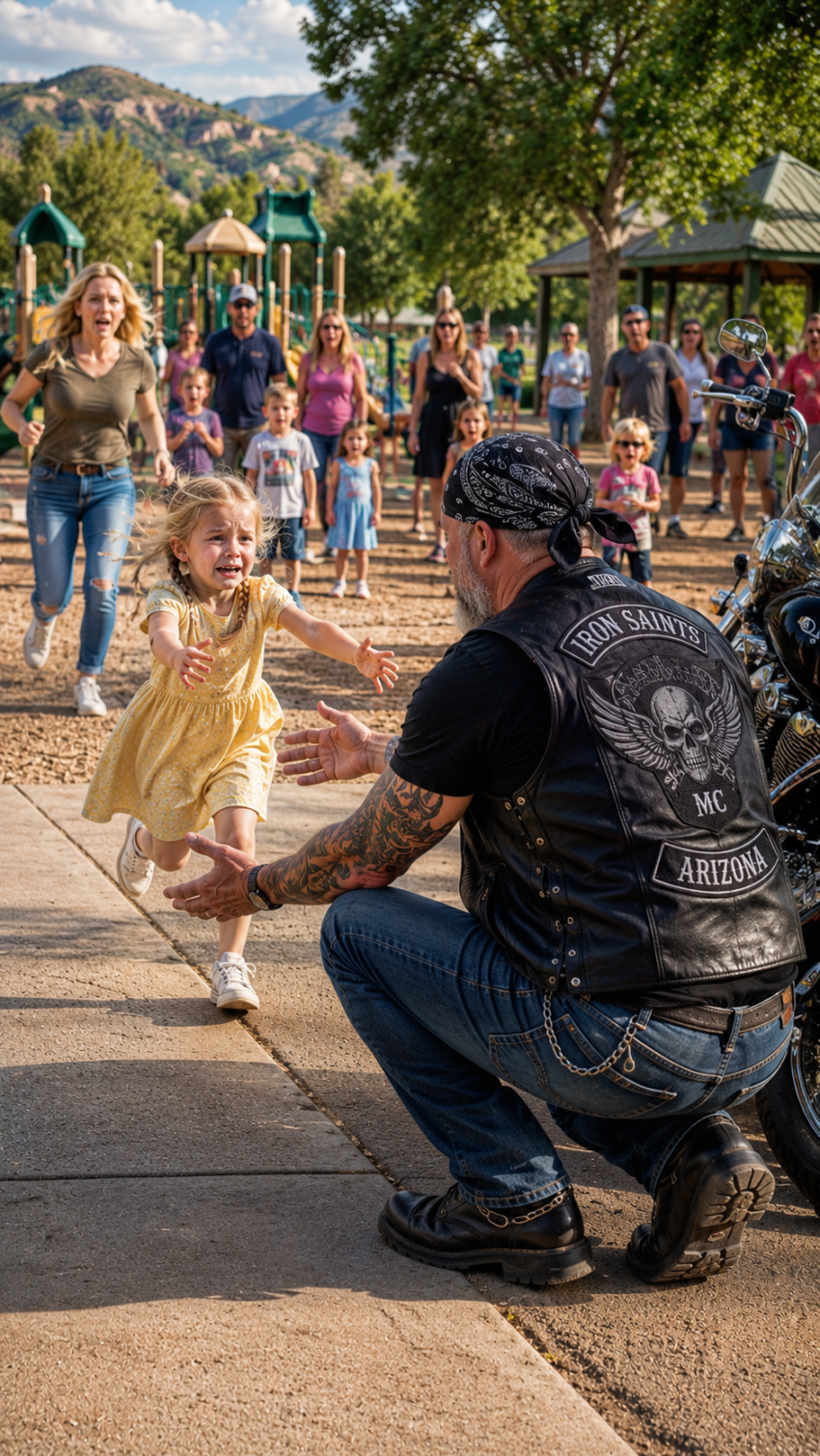
The Day the Playground Went Silent
The first thing people noticed about Warren Pike was always the leather.
Not his eyes.
Not the careful way he moved.
Not the fact that he always parked his motorcycle where he could see every exit.
They noticed the black vest first, the faded patches, the heavy boots, the gray beard, and the old blue tattoos running down both arms like weathered roads. They noticed the size of him too. Warren was six-foot-three, broad through the shoulders, with hands that looked strong enough to bend a wrench and a face most strangers misunderstood before he ever opened his mouth.
That was why the whole playground froze when a little girl ran straight into his arms.
It happened on a warm Saturday afternoon at McKinley Park in Boise, Idaho.
Families were scattered across the grass. Children climbed the jungle gym. A few parents sat under cottonwood trees with iced coffees and phones in their hands. Near the sidewalk, I was selling lemonade from a small stand for my sister’s church fundraiser when Warren’s motorcycle rolled into the parking lot.
The sound came first, low and deep, vibrating through the pavement.
Several parents looked up.
One woman pulled her son closer.
Another man muttered something under his breath.
Warren parked near the curb, shut the engine off, and stayed still for a second longer than usual. He did not remove his gloves. He did not walk toward the lemonade stand like he sometimes did. He turned his head slowly toward the far end of the playground.
That was when I saw the child.
She was maybe five years old, small and pale, with tangled blonde hair stuck to her cheeks. One white sneaker was missing. Her yellow dress was wrinkled, and one sleeve hung loose at the shoulder. She was not crying loudly.
That made it worse.
She was making a small broken sound, the kind a child makes when she is too tired to ask for help the normal way.
Warren saw her before anyone else truly understood what they were seeing.
A white SUV was backing out of a parking space too quickly. The little girl stepped toward the lane without looking. Warren moved with shocking speed for a man his size.
He crossed the asphalt, raised one hand toward the driver, and stepped between the girl and the vehicle.
The SUV stopped.
The driver shouted something.
Warren never looked away from the child.
He lowered himself to one knee, slowly, carefully, leaving space between them. Then he opened both hands, palms up, as if he were showing her he carried nothing but patience.
“Hey, sweetheart,” he said softly. “You don’t have to come to me. Just don’t step into the road.”
The little girl stared at him.
Then she looked over her shoulder.
I followed her eyes and saw a woman near the benches. She was well-dressed, blonde, and polished, wearing sunglasses and holding a designer purse. At first glance, she looked like the kind of mother people trusted without question.
But her face changed when she saw the little girl near Warren.
It was not fear.
It was anger.
The girl saw it too.
Her entire body shook.
Warren noticed.
His voice stayed low.
“Nobody is going to rush you,” he said. “You get to breathe first.”
The child took one tiny step toward him.
Then another.
Then she ran straight into his chest.
Warren caught her gently, not like a man grabbing something, but like a man receiving something fragile. He wrapped one arm around her back and sat down sideways on his parked motorcycle, both boots planted on the ground, the engine off, the child safely between him and the gas tank.
He did not try to leave.
He did not start the bike.
He simply became still.
Then the woman began screaming.
“That man has my daughter!”
Every head in the park turned.
Within seconds, the whole story seemed to write itself in people’s minds. A rough-looking biker. A frightened little girl. A mother shouting for help.
Two fathers walked toward Warren.
One of them said, “Put the child down.”
Warren did not argue. He did not raise his voice. He lifted one hand slowly, showing his phone.
“I’m calling for help,” he said.
The child clung harder to his vest.
The woman hurried closer, her voice suddenly sweet.
“Come here, Lily. Come to Mommy now.”
The girl buried her face against Warren’s chest and whispered something so quietly I almost missed it.
But Warren heard.
His jaw tightened.
Then he said into the phone, “McKinley Park. Young child in distress. I am seated on a parked motorcycle near the playground. The engine is off. I am not leaving. Please send officers and child welfare support.”
The woman’s face hardened.
“You have no right,” she snapped. “You don’t know anything about my child.”
Warren looked at her then.
His eyes were tired, steady, and full of something deeper than anger.
“I know she ran to a stranger because the stranger felt safer than you.”
The park went quiet.
The Man Everyone Misjudged
Most people in Boise thought they knew what Warren was.
They saw his motorcycle and his tattoos and built the rest of the story themselves.
But I had seen another side of him long before that day.
Warren belonged to a small motorcycle club called the Silver Cross Riders. They were not what people imagined. Most of them were older men with sore knees, old regrets, and soft hearts they kept hidden under leather. One was a retired mechanic. One drove a school bus. One volunteered at a food pantry. Warren was their road captain, which meant he rode in front and watched for trouble before anyone else did.
That suited him.
Warren had always watched for trouble.
Years earlier, he had worked as an emergency responder outside Twin Falls. He knew how fear looked in a body. He knew the difference between a child throwing a tantrum and a child trying to survive a moment too big for her.
He also knew loss.
His wife, Marla, ran a small secondhand shop not far from downtown Boise. She was gentle, practical, and the only person who could make Warren lower his voice just by saying his full name.
They had once had a daughter.
Her name was Annie.
She had lived only eleven days.
Warren never talked about it. Marla once told me that after Annie passed, Warren folded one tiny pink sock into the inside pocket of his leather vest and never took it out. From the outside, his vest looked intimidating. Inside, over his heart, he carried a piece of the daughter he never got to raise.
That was why he had a small patch sewn on the inside lining.
One word.
Annie.
Most people never saw it.
But that day at the park, when the little girl grabbed his vest, the leather shifted open, and I caught a glimpse of the stitching.
Warren had not become soft that day.
He had always been soft in places people never bothered to look.
The Truth Beneath the Yellow Dress
The first officer arrived within minutes.
Her name was Officer Dana Brooks. She stepped out of her patrol car with both hands visible, calm but alert.
“Sir,” she called, “I need you to stay where you are.”
Warren nodded.
“I’m not moving.”
The woman rushed toward the officer.
“He took my daughter. He’s dangerous. Look at him.”
Officer Brooks did look at him.
Then she looked at the child.
That was the first moment the story began to turn.
The little girl was gripping Warren’s vest with both fists. Her face was hidden against him, and every time the woman stepped closer, her shoulders jumped.
Officer Brooks raised one hand toward the woman.
“Ma’am, please stay back for a moment.”
“I’m her mother.”
“I understand. Please stay back.”
The woman’s expression cracked. Not fully. Just enough for something cold to show through.
Warren looked down at the child.
“Sweetheart,” he whispered, “the officer is here now. You’re not in trouble.”
The girl lifted her face just enough to speak.
“Please don’t make me go yet.”
No one moved.
A female paramedic arrived soon after. She knelt a few feet away and spoke gently, asking the girl her name.
The woman answered first.
“Her name is Lily.”
The child shook her head.
Officer Brooks noticed.
“Can you tell me what you like to be called?” the officer asked.
The girl pressed her cheek against Warren’s vest.
“Mia,” she whispered.
The woman laughed sharply.
“She gets confused. She makes things up.”
But Mia did not look confused.
She looked terrified.
The paramedic asked if she could check her arm where the dress sleeve had torn. Warren repeated every word softly, making sure Mia understood she could say no.
After a long moment, Mia nodded.
The paramedic moved the fabric back.
The crowd changed.
No one shouted now.
No one accused Warren now.
The marks on the child’s arm were not dramatic like a movie scene. They were quiet, small, and heartbreaking. Old discoloration near the shoulder. A thin adhesive bandage on her upper arm. Skin that looked too pale under the summer sun.
The woman immediately began explaining.
“She has medical issues. She bruises easily. You people are making this something it isn’t.”
Officer Brooks asked for the doctor’s name.
The woman gave one too quickly.
Dispatch could not confirm it.
The paramedic asked Mia when she had last eaten.
The child looked at Warren first, as if asking permission to tell the truth.
He gave the smallest nod.
“Yesterday morning,” she whispered.
A mother near the swings started crying.
The man who had told Warren to put the child down removed his baseball cap and stared at the ground.
Warren did not look satisfied.
He looked broken.
The Moment Warren Became a Wall
The woman tried again.
She crouched slightly and opened her arms.
“Mia, baby, come here. You know Mommy loves you.”
Mia screamed.
It was not loud for long, but it cut through the park like glass. Warren did not hold her tighter. He did not pull her away. He simply turned his body sideways, making himself a barrier between the child and the woman.
Not a weapon.
A wall.
Officer Brooks stepped in.
“Ma’am, I need you to come with me and answer a few questions.”
“This is ridiculous.”
“Now, please.”
The woman’s voice dropped.
“You have no idea what you’re doing.”
Warren finally looked up.
“That makes two of us,” he said quietly. “But the difference is, I’m trying to protect her.”
The officers separated everyone. Child welfare was called. The paramedic placed a blanket around Mia’s shoulders, but Mia refused it until Warren took it first, rubbed it between his hands, and said, “Feels warm. Smells clean.”
Only then did she accept it.
For nearly an hour, Mia would not let go of the edge of his vest.
When child services finally guided her toward the ambulance for a full checkup, she reached back.
Warren did not grab her.
He offered two fingers.
She held them until she had to let go.
That was Warren’s way.
Enough to comfort.
Not enough to control.
Before she left, Mia looked at him and whispered, “Will you still be here?”
Warren swallowed hard.
“As long as they let me.”
The Child Who Chose Tomorrow
The investigation moved slowly after that.
There were interviews, court hearings, medical appointments, and paperwork thick enough to make kind people feel helpless. Warren hated the slowness of it, but he respected the process because he knew Mia needed safety that would last longer than one brave afternoon.
He and Marla were allowed to visit weeks later.
They did not arrive with big promises.
They arrived with routine.
Marla brought peanut butter crackers because Mia liked snacks she could count. Warren brought a small wooden bird he had carved in his garage. He sat near the door every visit, never blocking the exit, never asking Mia to hug him, never acting hurt when she stayed quiet.
At first, she barely spoke.
Then one afternoon, she pointed at his vest.
“What does that word mean?”
Warren looked down.
The inside lining had shifted just enough for her to see the hidden patch.
Annie.
Marla’s eyes filled with tears.
Warren opened the vest a little more.
“That was my daughter’s name,” he said.
“Where is she?”
He took a long breath.
“She couldn’t stay.”
Mia touched the edge of the patch.
“Did you love her?”
Warren’s face changed. It was the face of a man trying not to fall apart in front of a child who had already seen too much pain.“Every second,” he said.
Mia thought about that.
Then she climbed onto his lap carefully and rested her head against his chest.
“You can love me a little too,” she whispered.
Warren closed his eyes.
Marla covered her mouth.
No one in that room moved for a long time.
The Home That Waited for Her
It took almost two years before Mia could stay with Warren and Marla forever.
Two years of questions.
Two years of checks.
Two years of people looking at Warren’s tattoos before they looked at the way Mia relaxed when he entered a room.
Some people wondered if a man who looked like him could give a child a peaceful home.
Marla answered with folders full of school reports, counselor notes, photographs, and letters from people who had watched Warren show up again and again.
Warren answered by showing up in clean shirts, speaking respectfully, and letting his actions do what his words never could.
In court, the judge asked him one simple question.
“Mr. Pike, why do you want to adopt this child?”
Warren looked at Mia sitting beside Marla, her small hand wrapped around a stuffed rabbit.
He did not give a speech.
He did not try to sound impressive.
He said, “I don’t want her to feel borrowed anymore. I want her to know where home is.”
The courtroom went quiet.
The judge looked at Mia.
“And what do you want, sweetheart?”
Mia glanced at Warren, then at Marla.
“I want tomorrow to feel safe,” she said.
That was when the judge signed the order.
Mia chose a new middle name for herself that day.
Grace.
She said it sounded like a door opening softly.
So she became Mia Grace Pike.
No Child Rides Alone
The Silver Cross Riders changed after that.
They had always helped quietly, but Mia gave their kindness a name.
They started a small fund for children entering emergency foster care. Backpacks. Clean clothes. Gas cards for foster parents. Stuffed animals. Grocery cards. Things nobody notices until a child has nothing.
Warren refused to put his name on it.
Marla named it anyway.
The Annie Grace Fund.
Every winter, men who looked like trouble walked into county offices carrying blankets, socks, and toys. The receptionists still tensed up the first time they saw them. Then they learned.
Leather can carry more than fear.
It can carry grief.
It can carry kindness.
It can carry a promise.
Once a year, on the Saturday closest to the day they met, Warren rides the same route to McKinley Park. He parks near the curb. He shuts the engine off. He sits for a few minutes with both boots on the ground.
No ceremony.
No speech.
Just memory.
Sometimes Mia goes with him. Sometimes she chooses not to, and Warren respects that too.
When she was seven, she sat on the parked motorcycle, safely between Warren and the tank, just like she had that first day.
“I like it better when the engine is off,” she told him.
Warren smiled a little.
“Me too, birdie.”
That became his nickname for her.
Birdie.
Because the first time he saw her, she looked like a small bird trying to fly out of a storm.
The Man at the Lemonade Stand
I saw them again last month.
Mia was almost eight then, taller and stronger, with two messy braids and a missing front tooth. She walked up to my lemonade stand with Warren three steps behind her.
Close enough to guard.
Far enough to let her lead.
She ordered strawberry lemonade and paid with two folded dollars from her own pocket.
Warren stood behind her, hands loose, eyes scanning the park the way guardians do. Not dramatic. Not controlling. Just aware.
A little boy nearby pointed at him and whispered to his father, “That man looks scary.”
Mia heard him.
She turned around, holding her lemonade with both hands, and looked at the boy with the calm confidence of someone who had learned that appearances tell only the first page.
“He’s not scary,” she said. “He’s my dad.”
Warren looked away fast.
But I saw his eyes.
The motorcycle waited at the curb, shining under the afternoon sun. Warren took Mia’s empty cup when she handed it to him. She slipped her small hand into his giant one, and together they walked back across the parking lot.
No hurry.
No roar.
No fear.
Just a little girl and the man everyone had misjudged.
The engine stayed off until Mia nodded.
And even then, Warren waited one more second.
Because love, real love, does not rush a child back into noise.
It waits until she is ready.
Some people still see the vest first.
Mia never does.
She sees the man who stayed.
She sees the father who did not need to look gentle to be gentle.
She sees the wall that stood between her and the life she was finally allowed to leave behind.
And every time Warren puts on that old black leather vest, the hidden patch inside rests against his heart.
Annie.
The daughter he lost.
Mia Grace.
The daughter who found him.
Ten Messages to Remember
Sometimes the safest person in a room is not the one who looks polished, calm, or socially acceptable, but the one who notices fear before anyone else chooses to believe it.
A child’s silence should never be mistaken for peace, because some children learn to become quiet only after the world has taught them that speaking does not always bring help.
True protection does not need to be loud, aggressive, or dramatic; sometimes it is simply a steady adult staying calm, planting both feet on the ground, and refusing to look away.
The way someone looks on the outside can never tell the full story of what they carry inside, because even the roughest leather can hide grief, tenderness, and a heart still trying to heal.
Warren did not save Mia by acting like a hero; he helped her by becoming a safe place that did not move, did not shout, and did not demand anything from her.
Many people in the park judged the scene too quickly, but the truth reminded them that eyes can be fooled when the heart is too eager to believe appearances.
The smallest details often tell the biggest truths: a missing shoe, a torn sleeve, a child looking at the road instead of the playground, and a stranger who understands what those signs might mean.
Healing does not happen all at once; it happens through routine, gentle voices, safe rooms, patient adults, and the slow discovery that tomorrow does not have to feel like yesterday.
A family is not always the people who claim you first; sometimes family is the person who stays long enough to help you remember that you are worth protecting.
The world needs more people who are willing to be a wall for someone smaller, not to control them, not to own them, but to give them enough safety to choose their own way forward.