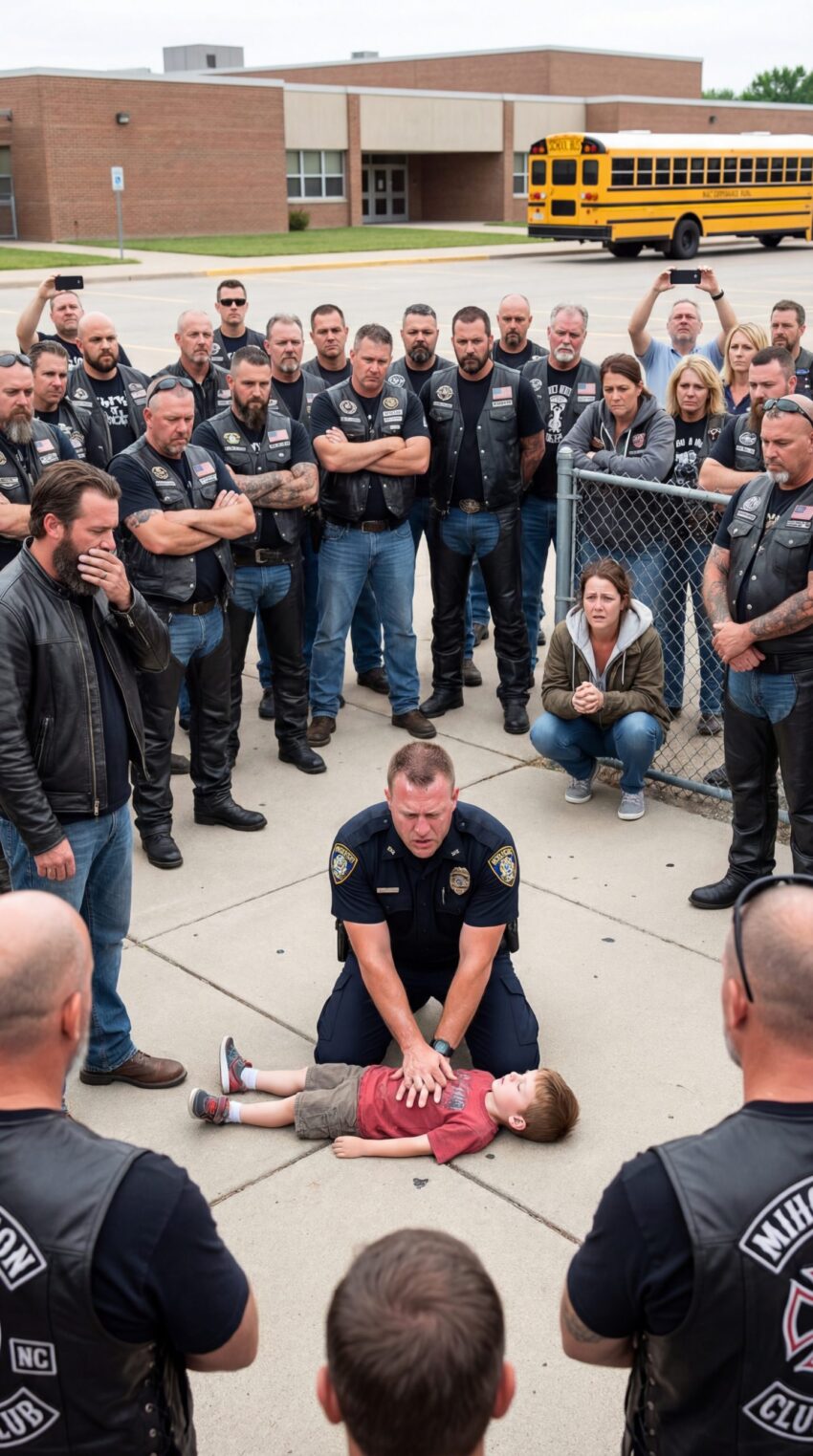
A Circle Formed for Protection, Not Conflict
Late in the afternoon, under a heavy Florida sky that threatened rain but never quite delivered it, traffic slowed along a quiet stretch of road just outside Lakeland. It was the kind of place where nothing unusual ever seemed to happen—until that day.
A patrol vehicle sat angled across the shoulder, its lights flashing in rhythmic bursts of red and blue. Drivers passing by instinctively eased their speed, curiosity pulling their eyes toward the scene.
At the center of it all, a police officer knelt on the asphalt, his focus locked onto something hidden from view.
Then came the sound.
Low at first. Distant. Growing.
Motorcycles.
One by one, then in clusters, riders began arriving. Leather vests, worn boots, steady expressions. They didn’t rush. They didn’t shout. They simply parked and stepped forward.
And then, without a word, they formed a circle around the officer.
From a distance, it looked tense. Unpredictable.
But what people thought they saw—and what was truly happening—were two very different things.
The Boy No One Could See

Officer Daniel Reeves had been the first to arrive after a call came in about a minor roadside accident. Nothing serious, dispatch had said.
But when he pulled up, he knew immediately it wasn’t minor.
A small bicycle lay twisted near the edge of the road. Just a few feet away, a young boy—no older than six—lay motionless on the pavement.
His mother was nearby, her voice breaking as she called out his name again and again, her hands trembling helplessly in the air.
Reeves didn’t hesitate.
He dropped to his knees and began chest compressions, counting under his breath, forcing himself to stay calm.
“Come on, kid… stay with me,” he murmured, his voice tight with urgency.
Thirty compressions.
Two breaths.
Again.
The world around him faded into noise. The flashing lights. The slowing traffic. The distant voices.
All that mattered was the rhythm.
All that mattered was the boy.
The Arrival That Changed the Scene

The first motorcycles arrived while Reeves was still counting.
Then more.
And more.
Drivers began whispering to each other.
“They’re surrounding him…”
“This doesn’t look good…”
Another patrol unit pulled up from the opposite direction. Two deputies stepped out, cautious, scanning the growing group.
But the riders didn’t move toward the officer.
They didn’t crowd him.
Instead, they adjusted their positions—quietly, deliberately—forming a barrier between the scene and the road.
One of them, a tall man with broad shoulders and a calm, steady presence, raised his hand slightly toward approaching cars.
“No one comes through here,” he said firmly.
Not aggressive.
Not loud.
Just clear.
The message wasn’t about control.
It was about protection.
A Father Steps Forward

That tall rider was named Garrett Boone.
He hadn’t planned to stop that day. He’d been heading somewhere else entirely when a message from a fellow rider mentioned a child down on the road.
Something in him told him to turn around.
He didn’t know why.
Not until he saw the small sneaker lying near the center of the circle.
Not until he saw the boy.
His boy.
For a moment, the world went silent.
Ten years earlier, Garrett had stood on another roadside, frustration burning inside him after an encounter with law enforcement that had cost him more than just money. That memory had stayed with him, heavy and unresolved.
And now—
An officer was kneeling over his son, fighting to bring him back.
Garrett didn’t run forward.
He didn’t shout.
Instead, he turned slightly and spoke to the men around him.
“Hold the space. Let him work,” he said quietly.
They listened instantly.
No hesitation.
No questions.
The circle widened just enough to give room.
Cars were gently redirected.
The road became still.
The Moment That Held Everything Together

Time stretched in a way that felt unreal.
Reeves’ hands continued their rhythm, though his arms began to ache.
“Stay with me… you’re not done yet,” he whispered, barely aware he was speaking out loud.
The boy’s chest barely moved.
The mother’s voice had softened into quiet sobs.
The air felt heavy.
Then, in the distance, a siren.
An ambulance.
Closer.
Louder.
Hope.
The paramedics rushed in, and the circle opened immediately, as if everyone had rehearsed it.
One medic dropped beside Reeves and checked for a pulse.
Seconds passed.
Too long.
Then—
“We’ve got something. It’s faint… but it’s there.”
The shift was instant.
The mother collapsed in relief.
Garrett closed his eyes, his breath catching for just a moment.
Reeves leaned back slightly, exhaustion finally catching up with him.
For the first time, he looked up.
His eyes met Garrett’s.
There was no hostility.
No tension.
Just understanding.
What People Finally Realized

As the stretcher was lifted and moved toward the ambulance, the energy of the scene changed.
A woman who had been watching from her car stepped out slowly.
“They were stopping traffic,” she said quietly to one of the deputies. “If they hadn’t… someone could’ve driven right through here.”
The deputy nodded, glancing at the line of motorcycles.
The truth was becoming clear.
The circle had never been about confrontation.
It had been about protection.
The ambulance doors closed.
The siren returned.
And just like that, the moment moved forward.
Words That Carried More Than They Said
Garrett picked up his helmet but didn’t leave right away.
He walked toward Officer Reeves, stopping a few feet away.
“You didn’t have to push that hard,” Garrett said, his voice low but steady.
Reeves shook his head slightly.
“He’s a kid,” he replied. “That’s enough reason.”
Garrett nodded.
“Yeah… it is.”
A pause.
Then, simply:
“Thank you.”
It wasn’t a long sentence.
But it carried years of weight.
The Quiet Hallway
Later that evening, the hospital felt almost too calm compared to the chaos of the road.
Fluorescent lights hummed softly overhead.
Garrett stood near the vending machines, still in his riding gear, his posture finally relaxing just a little.
His son was stable.
Breathing on his own.
That word—breathing—meant everything.
Officer Reeves walked down the hallway, no longer in a rush, but still carrying the fatigue of what he had done.
“He’s going to be okay,” Reeves said.
Garrett let out a slow breath.
“They said you kept him going long enough.”
Reeves gave a small shrug.
“I just did what I was trained to do.”
But both of them knew it had taken more than training.
It had taken heart.
The Boy Who Opened His Eyes
When the boy finally woke up, his voice was soft, barely above a whisper.
“Did I fall?”
Reeves knelt beside the bed, just like before.
“You did,” he said gently. “But you handled it pretty well.”
The boy looked toward his father.
“Did you bring everyone?”
Garrett smiled, his eyes still tired but warm.
“Yeah,” he said. “Just in case.”
The boy’s eyes closed again, this time peacefully.
What Strength Really Looks Like
That night, the motorcycles left the hospital one by one.
No noise.
No attention.
Just quiet departures under a sky that had finally cleared.
People who had seen the scene earlier would tell different versions of the story.
Some would admit they had expected something bad to happen.
Others would say they had never seen anything like it.
But the ones who truly understood knew something deeper.
Strength doesn’t always raise its voice.
Loyalty doesn’t always come with force.
And sometimes, the most powerful thing people can do is stand still—and choose to protect instead of react.
Before leaving, Garrett looked at Reeves one last time.
“We won’t forget this,” he said.
Reeves nodded.
“Neither will I.”
And in that moment, something old softened.
Not erased.
But changed.
Messages That Stay Long After the Moment
Sometimes the most meaningful actions happen when no one is watching closely enough to understand them, yet they leave behind a feeling that lingers far longer than any headline ever could.
There are moments in life when people choose not to act out of anger, even when they have every reason to, and those choices quietly reshape how the world moves forward.
Real strength is often revealed not in how loudly someone reacts, but in how calmly they choose to hold space for something that matters more than their own emotions.
When people set aside their differences, even briefly, they create a kind of connection that cannot be forced and does not need to be explained.
The presence of others, when guided by intention rather than ego, can become a form of protection that speaks louder than any words ever could.
It is easy to misunderstand what we see at a distance, but understanding begins when we take a moment to look closer and question our assumptions.
There are times when gratitude replaces years of tension in a single breath, reminding us that perspective can shift faster than we expect.
Every act of care, no matter how small it seems, has the potential to become the reason someone else gets another chance.
The quiet decisions people make in critical moments often define who they truly are, far more than anything they say.
And in the end, what stays with us is not the noise, not the fear, not the assumptions—but the undeniable truth that when people choose compassion over conflict, something lasting is built between them.