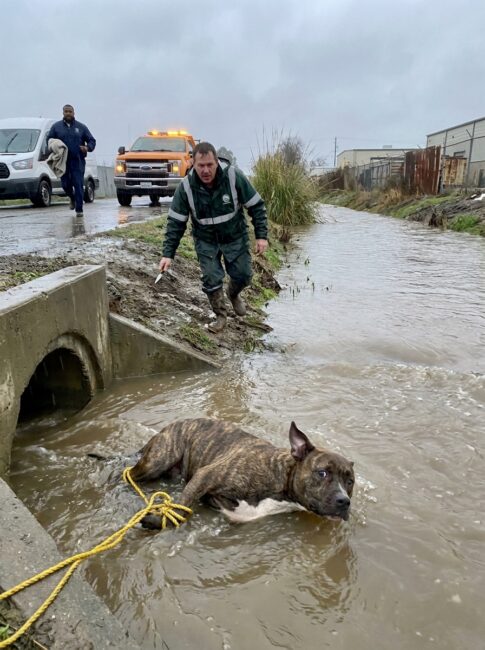
Part 2 — The Dog Who Feared a Water Bowl
Grace survived the first night.
Then the second.


By the third morning, her oxygen levels stabilized enough for Renee to remove the mask for short periods. The water she had inhaled irritated her lungs, and every cough made her whole body tighten, but the worst danger had begun to pass.
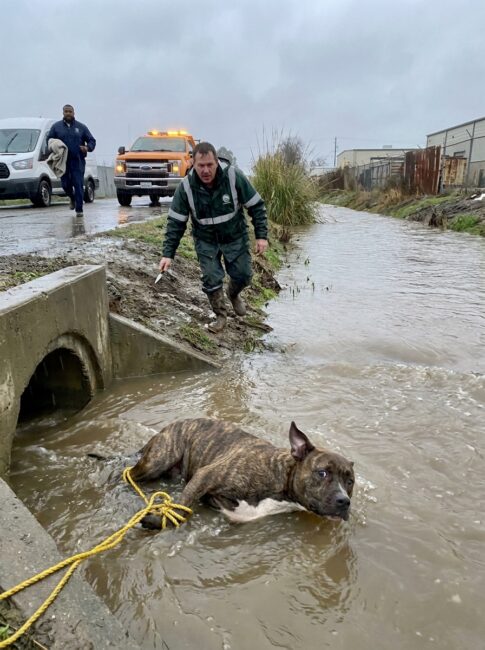
Her legs were another matter.
The rope had been tied long enough to restrict circulation and cut through skin. The front ankles were swollen. The back legs carried deep abrasions. One paw required stitches where the synthetic cord had sliced beneath the fur.
Yet no bones were broken.
Renee called that fortunate.
I understood what she meant, though fortunate was not the first word I would have chosen.
Grace remained at the clinic for nine days.
I visited before work and again after my shift. On the first morning, she watched me without moving. On the second, her tail slid once across the bedding. By the fourth, she attempted to stand when I entered.
Her legs folded.
She looked startled, then embarrassed in the way dogs sometimes do when their bodies betray them in front of someone they want to trust.
I sat on the floor beside the recovery pen.
“You don’t have to get up.”
Grace crawled close enough to rest her head against the gate.
The police investigation moved faster than expected because of the gas-station camera. The dark pickup belonged to Travis Cole, a thirty-nine-year-old local man who worked occasional construction jobs and had a history of domestic-violence complaints.
Grace had belonged to his former girlfriend, Melissa Grant.
Melissa contacted investigators after seeing a local news report about the rescue. She had fled Travis’s home six weeks earlier and believed Grace had been taken to a friend’s farm. Travis had told her the dog was “gone somewhere safe.”
Instead, according to messages recovered from his phone, he kept Grace to punish Melissa for leaving.
The morning before the canal rescue, Melissa refused to return to him.
That night, Travis tied the dog, drove to the drainage road, and threw her into the water.
The cruelty was not random.
Grace was used as a message.
Grace moved toward her in an uneven crawl, tail sweeping the blanket. Melissa buried her face in the dog’s neck.
“I thought you were safe.”
Grace licked her cheek.
It would have been easy to judge Melissa for leaving without the dog. Several strangers online did exactly that. But the police report showed she had tried. Travis had threatened her, hidden Grace, and claimed the animal had already been relocated.
Leaving an abuser is rarely one clean doorway.
Sometimes it is a series of desperate exits, each one missing something or someone loved.
Melissa wanted Grace back.
She also knew she could not provide safety yet. She lived in temporary housing that prohibited animals, worked two jobs, and was still dealing with threats.
“I don’t want her in another unstable place,” she said.
Her hands remained in Grace’s fur.
“Can you keep her?”
The question caught me unprepared.
I had not owned a dog since childhood.
I lived alone in a modest house with a fenced backyard and a small aboveground pool left by the previous owner. My daughter, Claire, lived in Atlanta and visited once a month. My workdays began early and sometimes ended late during storm season.
There were more experienced people.
Rescue organizations.
Foster families.
People who did not freeze at the sound of water moving through a culvert.
Yet Grace had begun watching the clinic entrance every morning at the time I arrived.
When I left, she waited beside the gate until the sound of my truck disappeared.
Renee asked me the same question she asked every emotional rescuer.
“Are you choosing the dog, or choosing the feeling of having saved her?”
I did not answer immediately.
The feeling of rescue is brief.
The dog remains after the photographs end.
There would be medications, training, accidents, vet bills, fear responses, and ordinary Tuesday evenings when nothing dramatic happened and commitment still had to arrive.
“I’m choosing her,” I said.
Grace came home with me three days later.
The first problem appeared before we entered the house.
It had rained.
A shallow puddle stretched across the driveway.
Grace stopped ten feet away.
Her body dropped low. Her ears flattened, and her breathing became rapid. She tried moving backward until the leash tightened.
I stepped around the puddle.
She followed.
Inside, she inspected every room, keeping her body close to walls. When she reached the kitchen, she saw the stainless-steel water bowl.
Grace froze.
The bowl was filled only halfway.
It did not move.
Still, she would not approach.
I replaced it with a shallow ceramic plate.
She remained across the room.
So I dipped my fingers into the water and placed droplets on the floor near her.
Grace licked them.
Then another.
That first evening, she drank from my cupped hands.
A dog cannot explain which part of trauma she remembers.
The cold.
The pressure.
The inability to move.
The water closing over her nose.
For Grace, water itself had become the shape of betrayal.
She refused the backyard when the grass was wet.
She panicked when I turned on the garden hose.
The sound of bathwater sent her under the dining table.
If rain began during a walk, she pulled toward home with enough force to injure herself.
I never made her continue.
People sometimes call that allowing fear to win.
I saw it differently.
For the first time in Grace’s life, fear was being allowed to communicate.
My job was not to overpower it.
My job was to prove that someone would listen before the rope tightened