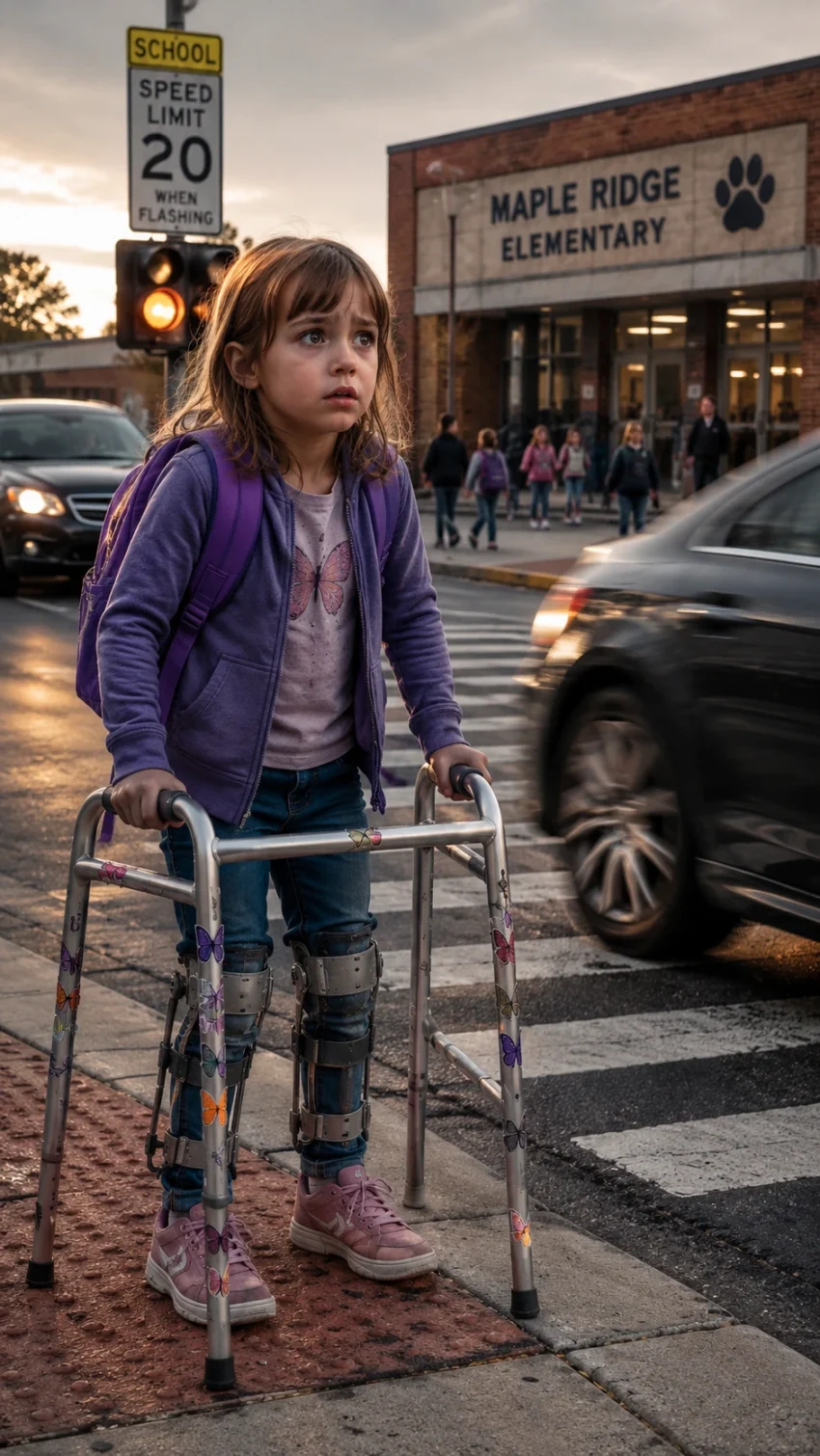
The morning rush outside Maple Ridge Elementary in Columbus, Ohio, had its own cruel rhythm—**car doors slamming, tires rolling too fast, adults hurrying through another day as if even a second of delay might break them**. The school zone signs stood clearly posted, but many drivers barely noticed them. Coffee steamed in cup holders. Radios murmured. Parents glanced at clocks and not at sidewalks.
At the edge of the crosswalk stood **eight-year-old Lily Bennett**, trying with all her strength not to panic.
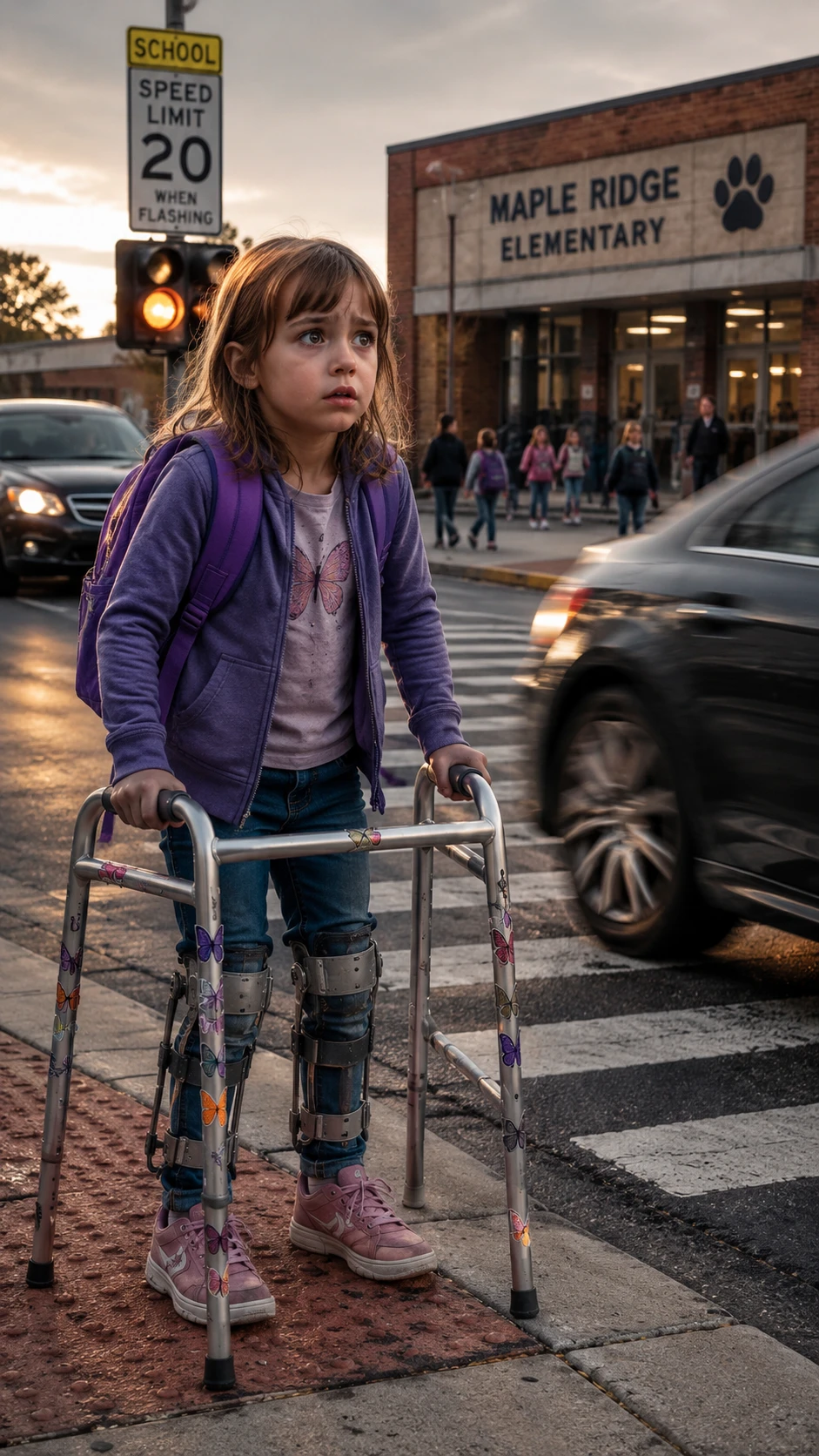
She wore **two metal braces on her legs**, tucked beneath faded blue jeans, and held tightly to a small silver walker covered in **purple, pink, and yellow butterfly stickers**. Her purple backpack sagged against her tiny shoulders. Across the street, the brick building of Maple Ridge Elementary looked so close. She could see children slipping through the front doors. She could hear their laughter. She could almost feel the warmth of the hallway inside.
But between Lily and safety was a stream of impatient traffic.
And the crossing guard was gone.
Lily bit her lip. She had done this before. She had practiced being brave. Her mother always told her, **“Take your time. Don’t let the world rush you.”** But the world was rushing anyway. The white walk signal flashed, then the countdown began. The numbers dropped too quickly. Her body did not move that fast. It never had.
She pushed her walker forward and took one careful step off the curb.
A car swung too close on the turn.
Lily gasped and jerked back, her heart hammering so hard it made her chest ache. For one terrible second, she thought she might cry right there in front of everyone. But people were already passing. Nobody stopped. Nobody asked if she was okay.
Then she saw them.
Across the parking lot near a diner, a group of bikers stood beside their motorcycles. **Leather vests. Heavy boots. Big bodies. Hard faces.** The kind of men adults lowered their voices around. The kind of men people judged before hearing a single word from them.
Lily didn’t care what they looked like.
She cared that they were there.
Taking a shaky breath, she called out, “**Excuse me… mister… can you help me cross the street?**”
The men went silent.
The tallest one turned first.
His name was **Grant Miller**, though the men in his motorcycle club called him **Road Bear** because he was massive—broad shoulders, thick beard, scar across one eyebrow, hands that looked like they could bend steel. But as soon as his eyes found Lily, something inside his expression softened.
He saw the braces.
The walker.
The fear.
And most of all, he saw that she was alone.
Grant crossed the parking lot at once, his heavy boots quick on the pavement. When he reached her, he dropped to one knee so they were eye level. “Hey, sweetheart,” he said, his voice unexpectedly gentle. “You want us to help you get across?”
Lily nodded, her eyes glassy. “I’m going to be late.”
“Then let’s fix that.”
Two more bikers approached. One was a gray-haired man everyone called **Duke**. Another, younger and tattooed, was named **Manny**. Without a word, they moved into place as if kindness were something they had practiced for years. Duke stepped into the road and lifted a hand, forcing traffic to stop. Manny walked on Lily’s left side. Grant stayed on her right, close enough to catch her if she slipped.
“Nice and easy,” Grant told her.
Lily took a step.
Then another.
Her braces clicked softly with each movement. The walker trembled against the pavement. Around them, engines idled impatiently, but none of the bikers cared. They moved at Lily’s pace and nobody else’s.
When they reached the other side, Lily let out a breath she’d been holding far too long.
“Thank you,” she whispered.
Grant smiled. “You got yourself across. We just came along for the ride.”
The bell rang from inside the school.
Lily looked toward the doors, and something in her face made Grant frown. She didn’t look relieved. She looked… worried. Not about being late. About something deeper.
“You need us to walk you in?” Manny asked.
Lily hesitated only a second before nodding.
So they did.
The sight turned heads immediately: **three large bikers walking a tiny girl with butterfly stickers on her walker up the path to an elementary school**. Parents stared. A teacher near the entrance froze. A few children whispered. Grant ignored all of it.
“What’s your name?” he asked.
“Lily.”
“That’s a pretty name.”
“My mom picked it,” she said.
The words were simple. But there was something in the way she said them—a pause, a weight—that made Grant glance down at her.
“Did your mom usually walk you to school?” he asked carefully.
Lily kept moving. “She used to.”
Grant felt his stomach tighten. “What about today?”
For a moment Lily said nothing. Then, with the kind of plain honesty only children have, she replied, “**She couldn’t come anymore. She died in February.**”
The world seemed to stop.
Even the other bikers went still.
Grant stared at her, speechless. Duke looked away sharply, jaw tightening. Manny inhaled like he’d just been punched in the chest.
Lily kept walking.
“As long as I leave early, I can usually make it,” she continued quietly. “Mom practiced with me before she got really sick. She said I was strong enough.”
Grant had buried people before. Friends. Brothers from the road. His own father. But something about the matter-of-fact way Lily said it—**not asking for pity, not even expecting sympathy**—cut deeper than he could explain.
“Who takes care of you now?” Duke asked, his voice rough.
“My dad works early. He drives delivery trucks.” Lily adjusted her backpack strap. “He drops me off near the corner before his shift because he says if he’s late again, he might lose his job.”
Grant shut his eyes for half a second.
There it was—that quiet detail.
This little girl wasn’t forgotten because she wasn’t loved.
She was walking alone because life had cornered her family so brutally that every option hurt.
By the time they reached the front doors, the school secretary had rushed outside, face pale. “Lily! We’ve been wondering where you were.”
Lily looked down. “The crossing guard wasn’t there.”
The secretary blinked, then looked up at the bikers. “Oh my goodness.”
Grant rose to his full height. “She almost got clipped out there.”
A teacher hurried over, apologizing breathlessly. The regular crossing guard had called out sick, and the substitute hadn’t shown up yet. The adults spoke in quick, guilty voices, but Lily’s eyes remained fixed on the floor.
Grant crouched again. “Lily, you okay?”
She nodded. “I’m used to it.”
Those four words nearly broke him.
He forced a smile. “Well, maybe you shouldn’t have to be.”
Lily finally looked up, and for the first time there was a faint spark in her expression, like she wanted to believe him but didn’t know whether it was safe.
Before she went inside, she did something small that none of them expected.
She wrapped her arms as far as they could go around Grant’s neck.
He froze.
Then carefully, as if holding something sacred, he hugged her back.
“Thanks, Road Bear,” she whispered.
Grant pulled away, startled. “How’d you know my name?”
“The other one said it,” Lily replied, pointing to Manny.
For the first time that morning, all three bikers laughed.
But after Lily disappeared into the school, none of them felt much like joking.
Grant turned toward the crosswalk again. Cars were already speeding by as if nothing had happened. “This is wrong.”
Duke nodded. “Yeah.”
Manny kicked lightly at the pavement. “We can’t just leave it.”
So they didn’t.
The next morning, at 7:15 sharp, the bikers were back.
This time there were five of them.
They parked near the same diner and watched the corner. At 7:38, an old sedan pulled up and stopped. A tired-looking man in a work uniform stepped out and helped Lily with her backpack. He looked worn down in a way Grant recognized instantly—the face of someone who had been surviving for too long to remember what rest felt like.
When he saw the bikers, he tensed.
Grant approached slowly, palms visible. “You Lily’s dad?”
The man nodded cautiously. “Yeah. I’m **Tom Bennett**.”
“Grant. We helped your daughter cross yesterday.”
Tom looked from one biker to another, confused, embarrassed, defensive all at once. “She told me.”
Grant glanced toward Lily, who offered a small wave. “We were thinking… until the school gets its act together, she shouldn’t be doing this alone.”
Tom’s face crumpled in a way he clearly hated letting strangers see. “I know,” he said softly. “I know she shouldn’t. I just—” He stopped and swallowed. “I’m doing the best I can.”
Grant believed him immediately.
Tom crouched to Lily’s level and adjusted the strap on her backpack. “Be good, bug.”
“I will.”
Then Tom stood, eyes red-rimmed, and said to Grant in a voice barely above a whisper, “Her mother handled mornings. Everything, really. Since she died…” He shook his head. “I’m still learning how to be two people at once.”
Grant looked at the man’s trembling hands and understood more than Tom had said.
“Then let us handle the corner,” Grant replied.
From that day on, the bikers made it their mission.
Every weekday morning, at least two of them were there.
They helped Lily cross.
Then they helped other children too.
They wore reflective vests over their leather, brought portable stop signs, and stood with quiet authority no speeding driver dared challenge. At first parents watched suspiciously. Then curiously. Then gratefully. Within a week, coffee appeared from the diner every morning with a note: **For the gentlemen keeping our kids safe.**
Lily changed too.
The fear slowly left her face.
She started smiling when she saw the motorcycles. She told them about math quizzes, library books, mean girls in class, and the gold star she got for reading aloud. Manny fixed a squeaky wheel on her walker. Duke brought butterfly decals when the old ones started peeling. Grant listened most of all.
One rainy morning, Lily asked, “Were you ever scared of school?”
Grant chuckled. “I was scared of a lot of things.”
“You don’t look like it.”
“That’s because people are bad at seeing what’s true.”
She considered that seriously. “Mom used to say that too.”
The words hit him hard.
Weeks passed. Then one afternoon, when Lily had already gone inside, Tom pulled his sedan to the curb and got out. He looked cleaner, less desperate somehow, though still tired.
“I got a different route,” he told Grant. “Later start. Better pay.”
Grant smiled. “That’s good.”
Tom nodded. “School board also hired a permanent crossing guard after parents started making noise. Apparently a bunch of them wrote letters.”
“Good.”
Tom’s eyes moved to the group of bikers, then back to Grant. “You know, before all this, I probably would’ve told Lily to stay away from men who looked like you.”
Grant barked a laugh. “Wouldn’t have blamed you.”
“But I’d have been wrong.” Tom’s voice thickened. “She talks about you guys every day. Says when you stand there, she feels like nothing bad can happen.”
The compliment landed with more force than any praise Grant had received in years.
A few days later, Maple Ridge Elementary held a small assembly. The principal stood at the podium while rows of children squirmed in folding chairs. At the front, awkward in clean jeans and polished boots, sat Grant, Duke, Manny, and the others.
The principal cleared her throat. “Today we want to thank some community members who reminded us what looking out for one another really means.”
The applause started politely.
Then Lily, sitting in the front row, rose with her walker and turned toward the students.
“These are my biker friends,” she announced proudly. “People think they’re scary, but they’re not. They’re the reason I don’t have to be scared anymore.”
The room went silent.
Then the applause returned—louder this time, real and full and rising until even the toughest biker there looked close to tears.
Grant had spent years being misread on sight.
Too big.
Too rough.
Too dangerous.
Yet here he was, in an elementary school gym, honored not for strength or intimidation, but for stopping long enough to help a frightened little girl ask for what she needed.
After the assembly, Lily rolled toward him and handed him a folded piece of construction paper. On the front, in crooked marker, were the words:
**TO ROAD BEAR
THANK YOU FOR WALKING AT MY SPEED**
Grant opened it and had to blink hard before he could see clearly.
Inside was a drawing.
A little girl with braces.
A line of huge bikers around her.
And above them, an oversized sun.
At the bottom Lily had written one more sentence in careful, uneven letters:
**Mom says good people don’t always look the way you expect. I think she was right.**
Grant stared at the page for a long moment.
Then he folded it gently and placed it inside his vest pocket, right over his heart.
That was where he kept it from then on.
Not because it made him feel heroic.
But because it reminded him of something far more important:
**the world had almost let Lily struggle through alone, and all it took to change everything was for someone to kneel down, listen, and walk beside her.**