The Long Way Home
On the last Friday of October, in a worn apartment on the edge of Stockton, California, Marisol Vega stood in her kitchen trying to stretch one small paycheck across a week that had already asked too much of her. The beans on the stove were almost done, the old refrigerator rattled like it was holding itself together out of stubbornness, and her nine-year-old daughter, Ivy, sat at the table doing spelling homework with a pencil so short it barely fit in her hand.
Then Marisol’s younger brother, Denny, said the one thing he should have kept to himself.
“You keep wearing yourself out for that girl, and for what?” he snapped. “She’s still going to grow up with nothing.”
The room went silent.
Marisol turned so fast the dish towel slipped from her hand. Her face changed in an instant, going from tired to wounded to furious in a way that made Denny step back even before she spoke.
“Don’t you stand in my house and decide what my daughter’s life will be,” she said, her voice shaking.
Denny grabbed his keys off the counter and laughed the kind of laugh people use when they want to hide from their own shame.
“Life already decided for you,” he muttered, and stormed out.
The door slammed hard enough to make the cheap framed print on the wall tilt sideways.
For a second, Marisol did not move. Then she turned and saw Ivy staring down at her workbook, eyes wide, lips pressed together.
“Mom,” Ivy said quietly, “are we really that poor?”
Marisol crossed the room at once, knelt beside her daughter, and held her face with both hands.
“Listen to me, baby. We are going through a hard season. That is not the same thing as being worth less. Do you understand?”
Ivy nodded, but not like she fully believed it.
Marisol brushed a loose strand of hair behind the girl’s ear. Her own hands were dry and cracked from cleaning rooms at a motel all morning and stocking shelves at a grocery store most nights.
“Money is not character,” she said softly. “It is not your future. It is not your value. Some people forget that because they have never had to fight for dignity. But you are not small, and your life is not small.”
Ivy looked up at her with solemn eyes.
“Then why do people act like it is?”
That question hurt more than Denny’s words ever could.
Marisol pulled her daughter into her arms and held her there until the little girl’s breathing slowed.
“Because some people judge fast and see slowly,” she whispered. “And because this world has too many people who walk away before they understand somebody.”
Ivy thought about that for a moment.
Then she asked, “Even if the person looks dangerous?”
Marisol leaned back enough to study her face.
She did not know that by the next morning, nearly a hundred bikers would line their street in absolute silence. She did not know that a man everybody warned people about would one day sit at her table like family. She only knew that her daughter was waiting for an answer.
So she gave the one she believed.
“Yes,” she said. “Even then. But you stay smart, you stay careful, and you never stop being honest with yourself. If you can help without losing yourself, then you help.”
Ivy nodded and returned to her homework.
The next afternoon, those words would follow her down a quiet road and change all of their lives.
The Sound Around the Bend

Ivy Vega always took the longer route home from school.
The short way cut through traffic, broken sidewalks, and a stretch of storefronts where older boys liked to make trouble. The longer way curved beside a rural road north of Stockton, where the hills were dry and pale and the wind smelled like dust instead of exhaust. Out there, the sky felt bigger. Out there, Ivy could imagine that life might widen one day.
She was small for nine, all sharp elbows and determination, with a backpack too heavy for her frame because she refused to leave library books behind. That afternoon she carried three of them, along with a math quiz she hoped her mother would not see too quickly.
The road was quiet until it was not.
The sound hit all at once—tires screaming, metal tearing, something massive sliding across asphalt. Then came a crash so violent it seemed to shake the air itself.
Ivy stopped walking.
Every warning her mother had ever given her came rushing back at once. Go the other way. Find an adult. Do not get pulled into something you do not understand.
But there were no adults nearby. No cars. No houses close enough to matter. Only the bend in the road ahead and a terrible silence hanging where the noise had ended.
Her heart pounded so hard it made her feel lightheaded.
She could run.
She could pretend she heard nothing.
Instead, with fear all the way down to her knees, she tightened her grip on her backpack straps and ran toward the curve.
The Man in the Ditch

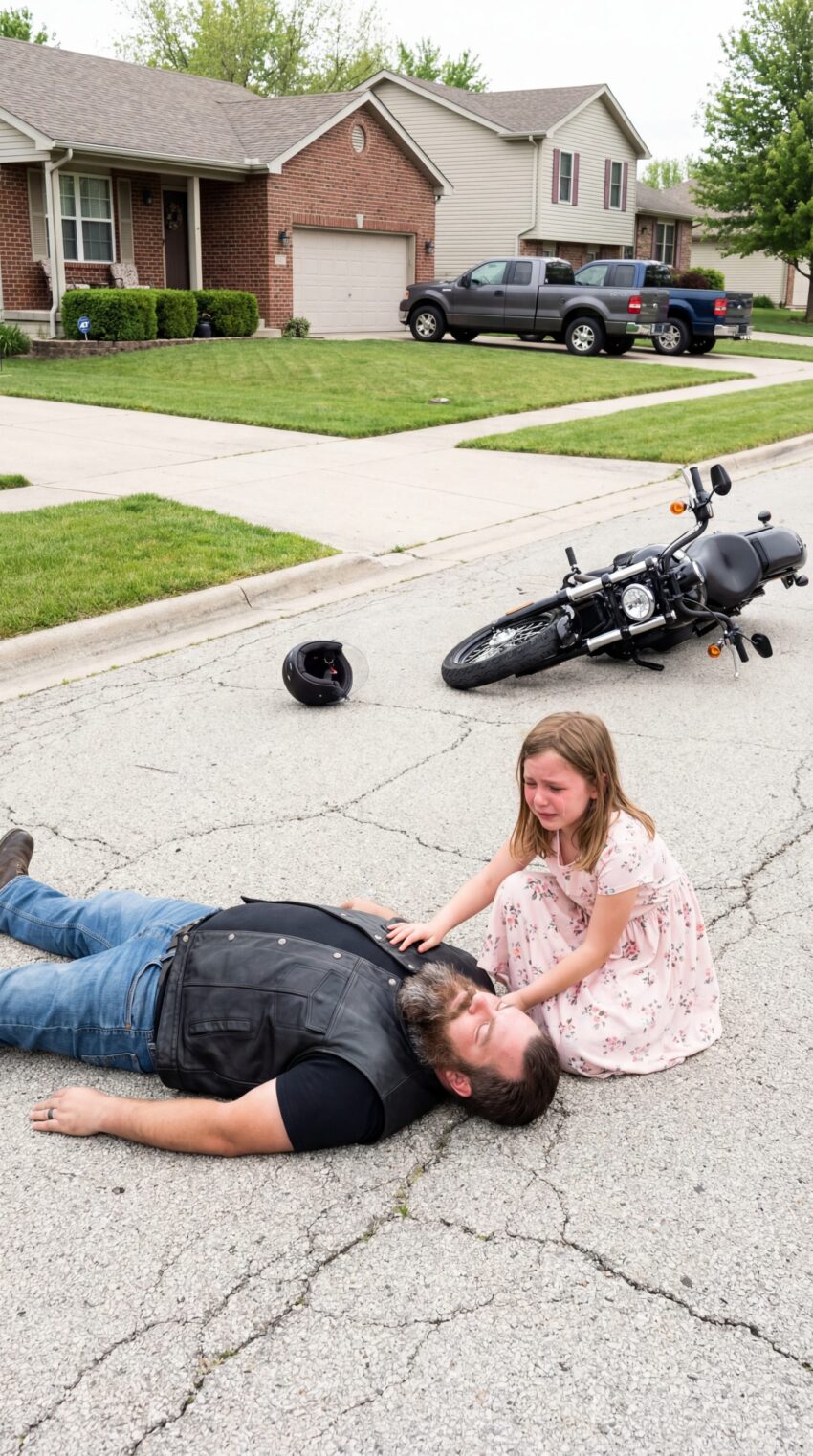
The motorcycle was lying half on the road and half in the weeds, black and enormous, still ticking with heat. One saddlebag had burst open. A long scrape marked the pavement. Twenty feet away, in the dirt and dry grass, lay the rider.
Ivy stopped so suddenly her shoes slid.
He was the biggest man she had ever seen in real life. Broad shoulders. Heavy boots. A beard streaked with gray. A leather vest torn near the shoulder and covered in patches. One of them carried the familiar California rocker. Another showed rank. Even as a child, Ivy knew enough to understand what she was looking at.
He was not just any biker.
He was the kind adults whispered about.
Blood had run down one side of his face. His leg was twisted at an angle that made Ivy’s stomach turn. For one terrible second she thought she was already too late.
Then his eyes opened.
They were bright blue, startling against the dust and pain.
He saw her and tried to lift his head, but he could not.
“Kid,” he rasped. “Get out of here.”
His voice sounded rough enough to scrape the air.
Ivy could not move.
He shut his eyes for a second and opened them again.
“Run,” he said. “You don’t want trouble from somebody like me.”
Somebody like me.
Those words landed harder than she expected. Not because she disagreed with them, but because he sounded like he already believed he was not worth stopping for.
Her mother’s voice rose in her memory as clear as if it had been spoken beside her.
The world has too many people who walk away.
Ivy dropped her backpack and slid down the ditch to kneel beside him.
“I’m not leaving,” she said, surprising herself with how steady she sounded.
He stared at her like she had lost her mind.
“You should.”
“Probably,” she admitted. “But I’m still here.”
A Child’s Courage

Ivy shrugged off her faded denim jacket and pressed it carefully against the side of his head where the bleeding seemed worst. The fabric soaked through almost immediately, and for one dizzy second she nearly pulled away.
But he made a low sound in his throat, and that sound reminded her this was not a scene from television. This was a real person. Hurt. Breathing. Still here.
So she held on tighter.
“What’s your name?” she asked.
He frowned like the question itself was absurd.
“What?”
“My mom says you keep people talking when they’re hurt. So what’s your name?”
He looked at her for a long moment.
Then he said, “Grim.”
Ivy narrowed her eyes.
“That sounds made up.”
One corner of his mouth moved just slightly.
“It’s the only one I use.”
“Well, I’m Ivy Mercer—” She stopped, corrected herself, and said, “Ivy Vega. I’m nine, and I’m going to be a doctor one day, so you need to cooperate.”
A broken laugh escaped him before he winced again.
“Bossy little thing.”
“My teacher says leadership is a gift.”
That got a real breath of laughter out of him, thin but genuine.
Ivy looked up the road and spotted an old pay phone still standing outside a shuttered service station. It looked ancient, but it was something.
“I have to call for help,” she said.
His eyelids dipped.
“They won’t get here fast enough.”
“Yes, they will.”
Then she stuck out her little finger, already stained from the blood on her jacket.
“Promise me you’ll stay awake until I get back.”
He stared at her hand.
There they were: a child in a school uniform and a feared biker lying broken in a ditch, making a pinky promise under a California sky.
Slowly, with visible effort, he lifted one hand and hooked his finger around hers.
“I promise,” he whispered.
“Don’t break it.”
“I know the rules.”
She nodded and ran.
The Call and the Return
The pay phone was harder to use than she expected. Her fingers slipped. She dialed wrong twice. By the time the call finally went through, she was nearly crying from panic.
“911, what’s your emergency?”
The words poured out of her in a rush.
“There’s been a motorcycle crash on Copper Hill Road by the old station, and a man is really hurt and bleeding and you have to come now.”
The operator tried to calm her, asked her name, her age, whether she was safe.
Ivy looked back toward the ditch where Grim lay out of sight behind the bend.
“I have to go back to him,” she said.
“Stay on the line with me, sweetheart.”
But Ivy had already hung up.
When she ran back, he was still awake, though only barely.
She dropped to her knees and pressed the ruined jacket down again.
“I called. They’re coming. I came back.”
He looked at her through half-focused eyes.
“You came back,” he repeated, as if that surprised him more than the pain.
“I said I would.”
He swallowed hard.
“You don’t know who I am.”
Ivy glanced at the patches on his vest, then back at his face.
“I know enough.”
“That should make you leave.”
Instead she said, “Tell me something.”
“What?”
“Anything. So you stay awake.”
He stared up at the sky.
Then, very quietly, he said, “I have a daughter.”
Ivy blinked.
“Do you see her?”
The answer took too long.
“Not the way I should.”
“Why not?”
His face changed, not with anger but with regret.
“Because I kept choosing the wrong things and telling myself I still had time.”
Ivy pressed the jacket harder when the bleeding started again.
“That was a bad choice.”
A weak breath of amusement escaped him.
“Yeah. It was.”
“Then say sorry.”
“Life’s not that simple.”
“Maybe not,” Ivy said, “but not saying it makes it worse.”
His eyes found hers then, and for the first time she saw something in him that did not match the patches or the rumors or the fear surrounding men like him.
Sadness.
Heavy, old, and real.
Sirens, Fear, and a Mother’s Heart
The ambulance arrived a minute later, followed by deputies. Paramedics moved fast, voices clipped and focused. One glanced at the vest and went still for half a second before getting to work.
They asked Ivy questions while they lifted him onto the stretcher.
“What’s his name?”
“He said Grim.”
“That all?”
“That’s all he gave me.”
When they loaded him into the ambulance, his hand searched once through the chaos until Ivy took it for a second.
“You kept the promise,” she said.
His grip tightened weakly.
“So did you.”
At Mercy Valley Medical Center, a nurse cleaned Ivy’s hands while pink water swirled down the sink. A deputy began taking her statement, but before he could finish, the waiting room doors burst open.
Marisol came in breathless, terrified, still wearing the polo shirt from the motel and one shoe with the lace untied.
“Ivy!”
Ivy was out of the chair before her mother reached her. Marisol held her so tightly it almost hurt, then pulled back to inspect her face, arms, hair, knees, as if harm could still be hiding somewhere.
“Are you hurt? What happened? Why is there blood on your clothes?”
“I’m okay,” Ivy said. “It’s not mine.”
The deputy explained the crash. The location. The biker. The fact that Ivy had stayed until help arrived.
When he quietly mentioned who the man was and what club he belonged to, Marisol’s face lost color.
She turned slowly toward her daughter.
“You stayed with him?”
Ivy nodded.
“Why?”
The answer came without hesitation.
“Because you told me we help people even when we’re scared.”
Marisol closed her eyes for one brief second.
When she opened them again, they were full.
“I meant call for help.”
“I did that too.”
A broken laugh escaped Marisol in spite of herself, the kind that comes when a parent realizes their child has listened a little too well to the best thing they were ever taught.
An hour later, a surgeon came out and said the man had survived. Broken leg. Concussion. Heavy blood loss. Surgery had gone well. He would live.
Marisol thanked the doctor, but the knot in her chest did not loosen.
Then the deputy stepped closer and lowered his voice.
“There’s something else you should know. His club has been notified.”
She stiffened.
“And?”
“They’re probably going to come.”
“For what?”
The deputy glanced toward Ivy.
“To thank her.”
That did not comfort Marisol at all.
The Morning the Street Went Silent
The next morning, at 7:11, the whole block began to tremble.
Ivy rushed to the window first. Then she froze.
Motorcycles lined both sides of Alder Street, row after row of black and chrome, engines rumbling in deep unison. Men in leather vests stepped off with calm precision, not shouting, not showing off, not acting wild. Just present. Controlled. Dozens and dozens of them.
Ivy tried to count and lost track.
Marisol came up behind her and went pale.