“Father,” the boy finished.
The garden went dead silent.
Even the distant chatter from the other tables seemed to disappear.
The old man stared at the photo with trembling hands.
It was a hospital picture of a young woman lying weak in bed, smiling faintly, one hand resting on the same wooden flute.
The elegant woman beside him looked from the photo to the boy, suddenly uneasy.
The old man’s lips parted, but no sound came out.
The boy held the photo tighter.
“Mom said if I ever found you,” he whispered, “I should play the song you taught her.”
The old man shut his eyes like the words hurt.
Years ago, his daughter had fallen in love with a poor musician. He had called her a disgrace, cut her off, and told the family never to speak her name again.
Now her son was standing barefoot beside his table, hungry, shaking, begging for help.
“She’s dying,” the boy said, tears filling his eyes. “She told me not to hate you.”
A soft gasp came from the woman in black.
The old man looked at the carved symbol on the flute.
He had carved it himself when his daughter was twelve.
His hand began to shake so badly he had to set down his glass.
“She kept it,” he whispered.
The boy nodded, trying not to cry harder.
For one long second, the old man just stared at him—the same eyes, the same trembling mouth, the same quiet dignity his daughter had when she was hurt.
Then his face broke.
He stood up so suddenly his chair scraped the stone.
The guests froze as he stepped toward the boy.
His voice cracked in front of everyone.
“Bring the car,” he said. “Now.”
The boy looked up, stunned.
The old man knelt in his tuxedo on the garden path, took the boy’s muddy face in both hands, and whispered through tears,
The room went silent.
The woman on the sofa stared at him.
The man didn’t even look at her.
He dropped to his knees beside the maid, shaking, and wiped the juice from her face with his bare hands.
“Look at me,” he whispered. “Are you hurt?”
The maid tried to speak, but only a soft cry came out.
Her lips trembled.
“I didn’t want to tell you yet,” she whispered. “I was waiting for tonight.”
The woman in white stood up so fast her glass hit the table.
The man finally turned to her, eyes burning now.
“She is not the maid,” he said. “She is my wife. And she’s carrying your grandchild.”
The woman’s face lost all color.
The maid lowered her eyes, ashamed, still clutching her belly.
“I asked her not to tell anyone,” the man said. “I wanted to protect her until the papers were signed.”
The older woman looked at the maid again, but now everything had changed.
No servant.
No mistake.
Just the young woman she had humiliated in her own home.
Then the maid pulled a folded envelope from her apron with trembling fingers.
The man opened it.
His breath caught.
He looked up, eyes wet.
“It’s a girl,” he whispered.
The maid broke into tears.
And for the first time, the woman in white had nothing to say.
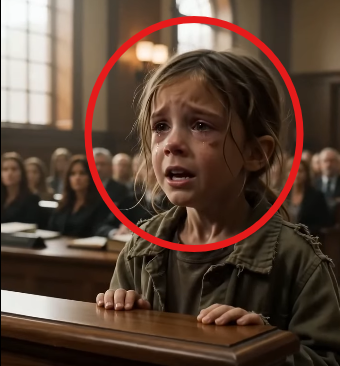
“Parents,” the little girl finished.
The word shattered the silence.
The mother let out a broken sob and nearly collapsed into the leaves. The father caught her, but his own hands were shaking now.
The little girl stepped closer to the stone and held out the toy soldier.
“He told me not to be scared,” she said. “He said I had to wait for you.”
The father took the soldier with trembling fingers. It felt heavier than it should.
He turned it over and found a tiny slit in the back.
Inside was a folded scrap of paper, protected from the dirt all these years.
His breath caught as he opened it.
The note was written in a child’s uneven handwriting.
They are not our real parents. But they loved us like real ones. Please find our little sister. Don’t leave her here alone.
The mother cried out and covered her mouth.
The little girl looked down at the wet leaves.
“They said my name is Lily,” she whispered. “They said if I ever saw the lady in the black coat, I should tell her they didn’t feel alone when they died.”
The mother stared at her through tears.
Years ago, the orphanage had told them the boys had no surviving family. They adopted them, loved them, and never knew a younger sister had been hidden away in another building.
The father’s voice broke.
The girl blinked slowly.
“The older one put it in my hand the night of the fire,” she said. “He told me to remember.”
The mother looked at the child’s face again.
Now she saw it.
The same eyes as the boys. The same mouth. The same frightened courage.
She crawled through the wet leaves toward her.
“Oh God,” she whispered. “You’re theirs.”
Lily’s lower lip trembled.
“For a long time,” she said softly, “I thought nobody came because nobody wanted me.”
The mother broke completely.
She pulled the little girl into her arms beside the gravestone and held her like she was holding the boys one last time.
And in the cold cemetery, between the two names carved in stone, the family they had buried in grief suddenly wasn’t gone at all.
The man’s hand lifted toward the photograph, then stopped in midair, trembling.
He looked at the girl as if one more word might destroy him.
“Where is she?” he asked.
The little girl slid off the stone step and stood in front of him, clutching the picture with both hands.
“She told me to wait here,” she whispered. “For the man in the striped tie.”
His breath caught so sharply it hurt.
No one else knew that detail. Not anymore.
He crouched in front of her, his eyes filling now, trying to keep his voice steady.
The girl swallowed.
His face broke.
That was his wife. The woman he had buried in his mind for six long years after the fire, after the empty coffin, after the lie he had been forced to live with.
He looked at the child again.
The same brown eyes.
The same trembling mouth.
The same way she held sadness in her face without understanding all of it.
“How old are you?” he whispered.
His hand went to his mouth.
Five.
He had lost Elena six years ago.
The girl reached into her pocket and pulled out a folded note, worn at the edges.
He opened it with shaking hands.
It was Elena’s handwriting.
If Anna finds you, don’t let them take her back. I never died. I was hidden.
He looked up, completely shattered.
“Anna?” he whispered.
The girl nodded.
Then she glanced down the street toward the glowing end of the alley and said, with heartbreaking calm,
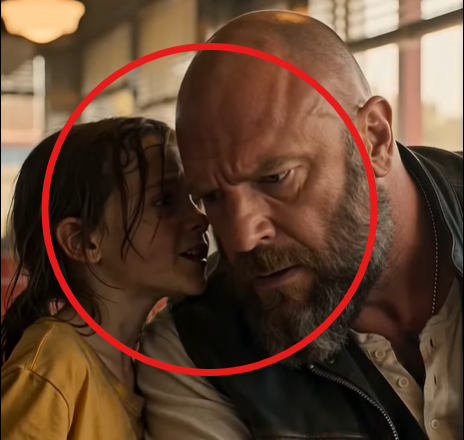
The biker took off his sunglasses.
His eyes were no longer hard.
They were shocked. Hurt. Almost afraid.
He looked down at the engraving again, and his hand started trembling around the tiny motorcycle.
It was a small winged skull burned into the metal by hand.
Only two people ever used that mark.
Him.
And his younger brother.
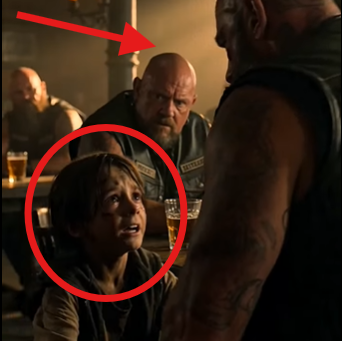
“Who is your dad?” he asked, voice breaking.
The boy swallowed hard.
“Tommy.”
The biker shut his eyes.
A few of the men behind him lowered their heads immediately. They knew that name.
Tommy had ridden with them years ago. Then he disappeared after a fight, after pride, after one terrible night nobody ever fixed.
The biker stared at the child again.
The same eyes.
The same trembling mouth.
The same stubborn way of trying not to cry.
He crouched lower.
“Where is he?”
The boy pointed weakly toward the road.
“In our trailer,” he whispered. “He got cold. He wouldn’t wake up. Mama’s gone. I didn’t know what else to sell.”
The biker looked like he’d been hit.
His brother had been alone.
This whole time, he had been alone.
The boy reached into his pocket and pulled out a folded scrap of paper.
“He said if it got bad, I should find the man with the same mark.”
The biker opened it with shaking fingers.
The note was short.
If you’re reading this, I was too late. Take care of my son better than I took care of you.
The biker’s face broke completely.
He pulled the crying boy into his arms right there in the dust, holding him against the leather vest that suddenly didn’t feel hard anymore.
“I’ve got you,” he whispered. “I’ve got you now.”
Then he stood up, still holding the boy, and turned to his men.
His voice shook with grief and urgency.
“Get the truck,” he said. “We’re bringing my brother home.”
The word died in the older woman’s throat.
The maid stood motionless, tears slipping down her cheeks, too frightened to move.
“My what?” she whispered.
The older woman closed her eyes for one second, like saying it would make it real.
Then she opened them and looked at the young woman’s face properly.
The same eyes.
The same mouth.
The same small tremble in the chin.
“My daughter,” she said.
The maid’s breath left her all at once.
“No…”
The older woman clutched the vanity to steady herself.
“Years ago, I had twin girls,” she said, voice shaking. “One got sick after birth. There was a fire at the clinic. They told me one baby died.”
The maid’s hand tightened around the pendant.
“The woman who raised me said I was left with her in the chaos,” she whispered. “She said rich people paid her to disappear.”
The older woman broke.
“I searched for you,” she said. “But my husband buried everything. He told me to stop asking questions.”
The maid looked at her with shock, hurt, and something softer trying to survive underneath it.
“All these years,” she whispered, “I was cleaning your house.”
The older woman stepped closer, trembling now, no pride left in her face.
“I didn’t know,” she said. “God help me, I didn’t know.”
The maid reached into her pocket and pulled out a folded paper she had kept for years.
“It came with the necklace,” she said.
The older woman opened it with shaking hands.
It was an old hospital tag.
Two baby names had been written on it.
One was crossed out.
The other was hers.
Her knees nearly gave way.
Then the maid said the one thing that shattered her completely.
“If I’m your daughter…” she whispered, “then the woman you call your heir is not.”
“Daughter,” the older woman whispered.
The maid stopped breathing for a second.
The room went so quiet that even the chandelier seemed afraid to move.
“My what?” the maid asked softly.
The older woman clutched the vanity to keep herself standing.
“Years ago, I gave birth to twin girls,” she said, her voice shaking. “One wore this necklace. The other wore its pair. Then there was a fire at the private clinic. They told me one baby died.”
The maid’s fingers rose slowly to the emerald at her throat.
“The nun who raised me said I was left at the convent with nothing but this,” she whispered. “She said powerful people paid to make sure no one came back for me.”
The older woman closed her eyes in pain.
“My husband,” she said. “He wanted only one heir. One perfect child. He told me the second baby was gone.”
Tears slipped down the maid’s cheeks.
“All these years,” she whispered, “I was serving my own family.”
The older woman looked at her properly now.
The same eyes.
The same chin.
The same small tremble in the mouth.
She reached out, but stopped just before touching her.
“I did not know,” she whispered. “God forgive me, I did not know.”
The maid let out one broken breath.
“Then who is the daughter everyone knows?”
The older woman’s face changed again. Not grief this time.
Fear.
She looked toward the bedroom door as if the walls themselves might be listening.
Then she opened the jewelry box fully and pulled out an old folded hospital card hidden beneath the velvet lining.
Her hands trembled as she read it.
Two infant names.
One had been crossed out.
The maid stared at the card, then back at her.
The older woman’s voice dropped to a whisper.
“If you are alive,” she said, “then the daughter sleeping under this roof… was never mine.”
The tray slipped in the maid’s hands and one glass tipped, ringing against the others before going still.
No one in the ballroom moved.
The maid stared at the man as if he had mistaken her for someone else.
“I’m not a princess,” she whispered.
The woman in white went pale.
The second man reached into his coat and pulled out a folded photograph and a royal signet ring.
“We have searched for you for nineteen years,” he said softly. “You were taken the night the palace car crashed.”
A murmur moved through the crowd.
The arrogant man stepped back from the maid as if her gray dress had turned into fire.
The maid’s lips trembled.
“No…”
The man opened the photograph.
It showed a little girl in a pale dress, standing between a king and queen, wearing a tiny necklace the maid still had hidden beneath her apron.
Her hand flew to her chest.
The elegant woman in white suddenly looked terrified.
The second man saw it too.
He turned toward her.
“She worked here because you arranged it,” he said.
The ballroom froze all over again.
The woman’s voice shook.
“I was told she died.”
“You were told to make sure she stayed forgotten,” he replied.
Tears filled the maid’s eyes as pieces of her life began falling into place all at once—the orphanage, the missing papers, the strange necklace, the feeling that she had belonged somewhere else.
The second man stepped closer, gentler now.
“Your father is alive,” he said. “He sent me to bring you home.”
The maid started crying without meaning to.
The arrogant man lowered his eyes in shame.
And the woman in white, who had laughed while the princess carried her champagne, could do nothing but watch as the whole room bowed to the girl they had treated like she was nobody.
The father’s face drained of color.
For one second, his hand loosened around his daughter in pure shock.
The little girl turned her face slightly toward the distant jogging woman, then lowered it again too late.
The father saw it.
He slowly removed her sunglasses.
Her eyes squeezed shut at first.
Then she started crying.
“Daddy…”
His voice broke.
“You can see me?”
The little girl nodded once, trembling.
The dirty boy stood there shaking, but he forced himself to keep talking.
“I watch from the back fence,” he said. “Your wife mixes drops into her dinner. Then she tells her to sleep.”
The father looked at his daughter again, horror spreading through him.
“Why didn’t you tell me?” he whispered.
The little girl’s lip shook.
“Mom said if I talked,” she cried, “you would leave me too.”
The words hit him like a knife.
He pulled her into his arms as she broke apart against his chest.
The boy pointed again toward the path.
“She said blind girls get more money,” he whispered. “And more pity.”
The father looked up.
The jogging woman was slowing down now, staring at them from a distance, realizing something had gone wrong.
His daughter clung to his jacket and sobbed harder.
Then, through tears, she whispered the part that shattered him completely.
“She also said… you’re not my real dad.”
The father froze.
The little girl looked up at him with terrified, pleading eyes.
And for the first time, the boy on the bench wasn’t the only one who felt like the ground had disappeared.
he woman went completely still.
Her fingers rose slowly to the pin on her coat, touching it like she no longer trusted it to be real.
The little boy stood frozen in front of her, breathing hard, his eyes full of fear and hope.
“What is your mother’s name?” she asked.
He tightened his grip around the pin.
“Lina.”
The woman’s breath caught.
Years ago, her younger sister Lina had vanished after a terrible fight with their family. Everyone said she had run away. Later, they were told she was dead.
The woman stared at the boy’s face.
Now she could see it.
The familiar eyes. The same mouth. The same softness in the expression when he was trying not to cry.
“Where is she?” the woman whispered.
The boy looked down for a second, ashamed.
“She’s sick,” he said. “She sells flowers near the bridge at night.”
The woman covered her mouth.
The boy’s voice shook harder now.
“She told me if I ever saw the lady with the other pin, I should stop her. Even if she got mad.”
Tears filled the woman’s eyes.
“Why didn’t she come to me herself?”
The boy blinked fast.
“She said you were rich now,” he whispered. “She thought maybe you forgot her.”
The words hit her like a wound reopening.
She dropped to her knees right there on the sidewalk so she could look at him properly.
“I never forgot her,” she said, voice breaking. “I searched for her.”
The boy’s face crumpled.
He pulled a folded paper from his pocket and handed it to her with trembling fingers.
“She told me to give you this if you believed me.”
It was a photo.
Two young sisters smiling, each wearing the same gold leaf pin.
On the back, in faded handwriting, were four words:
Find me before morning.
The woman looked up, eyes filled with panic now.
“Before morning?”
The boy nodded, tears sliding down his cheeks.
His voice came out small and urgent.
“She said if I found you too late… you’d only meet her at the hospital.”
The final notes trembled through the ballroom, and no one dared move.
The little girl looked up from the piano, frightened now by the silence she had created.
The older man stood in front of her, staring like he had seen a ghost.
“Who taught you that song?” he asked.
The girl swallowed hard and looked down at her hands.
“My mama,” she whispered.
His breath caught.
Years ago, he had written that melody for his little daughter—just for her—before she disappeared with her mother in a house fire everyone believed had taken them both.
He had never played it in public. Never written it down. No one else should have known it.
The girl reached into the pocket of her torn dress and pulled out a folded piece of paper.
“She told me if people laughed,” she said softly, “I should still play it. She said if you were here… you would know.”
His hand shook as he opened the note.
The handwriting made his face break before he even finished the first line.
If our daughter finds you, please don’t let them turn her away like they turned me away.
The man’s eyes filled with tears.
He looked at the child again.
The same eyes.
The same chin.
The same quiet way of trying not to cry.
The same daughter he had mourned for eight years.
The guests who had laughed at her stood frozen in shame as he slowly dropped to his knees in front of the barefoot child.
“What is your name?” he whispered.
The girl’s lower lip trembled.
“Clara.”
A shattered breath left him.
That was the name he had given his little girl.
He touched her face with trembling fingers, and when she didn’t pull away, he finally broke.
The child he had been too late to protect had just played her way back into his life.
The music kept moving under her fingers, but now the whole room was holding its breath.
The older man stepped closer to the piano, his face pale, his eyes wet in a way no one there had ever seen.
When the girl finished, the silence felt heavier than the laughter had.
She looked up at him, scared now.
“Was it bad?” she asked softly.
The man shook his head, but for a second he couldn’t speak.
“Who taught you that song?”
The little girl looked down at her torn dress.
“My mama,” she whispered.
His breath caught.
Years ago, he had written that melody for his daughter on this very piano. He had never published it. Never performed it. Never even played it for anyone else after the fire that took his wife and child.
Or so he had been told.
The girl reached into her pocket and pulled out a folded note.
“My mama said if people laughed at me,” she said, “I should still play it. She said one man would know.”
His hand trembled as he opened the note.
The handwriting made his knees weaken before he even finished reading.
If our daughter ever finds you, please don’t let them turn her away.
The man looked at the little girl again.
The same eyes.
The same chin.
The same frightened way of trying not to cry.
“What is your name?” he whispered.
The girl’s lower lip shook.
“Lila.”
A broken sound escaped him.
That was the name he had given his daughter.
Around them, the wealthy guests stood frozen in shame as the man slowly dropped to his knees beside the piano, tears finally falling.
And the little girl who had asked for food had just played her way back into her father’s arms.
The words broke something open in the room.
The crowd burst into applause, but the girl barely heard it.
She was staring at her own feet, crying and laughing at the same time, like she still couldn’t believe they were holding her.
The boy kept one hand in hers, steady and warm.
“You’re doing it,” he whispered.
She nodded, unable to speak for a second.
Behind them, the older man covered his mouth, tears spilling down his face.
He was her father.
The one who had sat beside hospital beds.
The one who had heard doctors say she would never dance.
The one who had smiled for her in daylight and cried for her in private.
Now he stood frozen, watching his daughter move under the chandeliers like a miracle had stepped into the room.
The boy spun her again, slowly.
Her dress shimmered.
The guests clapped louder.
Then, in the middle of the floor, she let go of his hand for one heartbeat and stood on her own.
The room went silent.
Her legs trembled.
Her chest rose sharply.
But she stayed standing.
Her father let out a broken sob.
The girl turned toward him with tears in her eyes and the brightest smile he had ever seen.
“Daddy,” she whispered, “look at me.”
He nodded through tears, completely undone.
And as the ballroom erupted again, the wheelchair stood empty behind her—the one thing in the room she no longer needed in that moment.
The woman lunged forward and wrapped both arms around her son.
He crashed into her chest, sobbing so hard he could hardly speak.
“I came back,” he cried. “I got help.”
She held his face in both hands like she needed to make sure he was real.
The biker helped her to her feet.
“Come on,” he said. “We’re getting you out.”
She was trembling so badly she could barely walk, but she didn’t let go of her son for a second.
They moved fast through the hallway.
Behind them, the abusive man shoved himself off the wall and staggered toward the front door, furious again.
“You’re not taking her!”
But when they stepped outside, he stopped cold.
The yard was no longer empty.
Every biker was there now.
A full line of motorcycles stood glowing in the last light of sunset, engines rumbling low, chrome shining, leather jackets still and silent like a wall.
No one smiled.
No one moved.
The young mother pulled her son close and started crying again, this time from relief.
The lead biker stepped forward, placing himself between them and the doorway.
The man’s anger drained right out of his face.
He looked at the boy, then at the row of bikers, then back at the woman he had terrified for too long.
The lead biker tilted his head once.
“Try it again.”
One engine roared louder.
Then another.
The man took a step back into the house, pale now, realizing for the first time that she was not alone anymore.
The woman buried her face in her son’s hair and collapsed against him, shaking.
And under the growl of the motorcycles, the little boy finally understood that this time, they were really getting away.
Her fingers touched his.
That was all it took.
The boy closed his hand around hers, gentle and certain, and the girl rose from the wheelchair with a shaky breath that sounded like fear and hope at the same time.
A gasp moved through the ballroom.
Her knees trembled.
Her father took a step forward, terrified she would fall.
But the boy stayed close.
“I’ve got you,” he whispered.
She looked at him with tears in her eyes.
He smiled like he already knew she could do it.
One step.
Then another.
The marble floor seemed to disappear beneath the sound of her breathing.
The crowd was no longer whispering.
They were staring.
The father’s face broke open with emotion he could no longer hide.
The boy led her slowly toward the center of the floor.
The music swelled.
He lifted her hand and turned her gently.
Her light blue gown opened under the chandeliers like a piece of sky.
She laughed through tears.
“I’m dancing,” she whispered.
The father covered his mouth, shaking now, because after the accident, after the doctors, after every night she cried that she would never dance at her own birthday ball, he had stopped knowing how to hope.
The boy turned her once more, slow and careful.
Then he let go for one heartbeat.
She stood on her own.
The ballroom exploded into applause.
The father began to cry openly.
The girl looked at the empty wheelchair behind her, then back at the boy.
“How did you know?” she whispered.
The boy looked down, suddenly shy, and pulled a folded paper from his pocket.
“She dropped this outside,” he said.
Her father took it with shaking fingers.
It was one page from the girl’s diary.
Please, God… just once, let somebody ask me to dance like I’m not broken.
The father’s knees nearly gave out.
And while the crowd kept clapping, the poor barefoot boy who had nothing had just given his daughter back the one moment money never could.
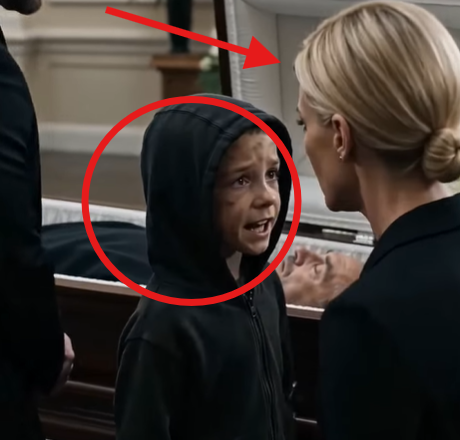
The scream that tore through the room did not come from the mourners.
It came from inside the coffin.
The maid gasped and ripped at the broken lid with both hands until the lead mourner finally dropped beside her and helped tear it open.
Inside, the young woman lay pale and weak, her fingers trembling, her lips barely moving.
She was alive.
One of the women in black collapsed into tears. The second man staggered back so fast he hit the wall.
The maid leaned over the coffin, crying now.
“I told you,” she whispered. “I told you I heard her.”
The woman inside struggled for breath.
“Water…” she rasped.
The room erupted into chaos.
The lead mourner stared down at her like he was looking at a ghost.
“No… no, we buried you…”
Her eyes fluttered open.
She turned weakly toward him, then toward the maid.
And through a shaking breath, she forced the truth out.
“They tried to make me disappear.”
The whole room froze again.
The maid clutched the edge of the coffin, sobbing from shock.
“Who?” the lead mourner asked.
The woman’s hand lifted weakly and pointed.
Not at a stranger.
Not at the door.
At the second man in the dark suit.
His face drained of all color.
The mourners turned toward him in horror.
The maid looked up, shaking.
The woman in the coffin swallowed hard, her voice breaking into a whisper.
“He said if I woke up… he’d finish it.”
And in the middle of the funeral meant for a dead woman, every eye locked on the man who had buried her alive.
The last note faded, but no one in the hall moved.
The man stared at the girl like the floor had opened under him.
“What did you say?” he asked.
The girl’s fingers stayed resting on the keys.
“My mother said you loved her,” she whispered. “But when she got sick… you sent her away.”
A murmur ran through the crowd.
The man’s face drained of color.
Years ago, he had been rich, admired, and terrified of scandal. He had hidden the woman he loved when she became pregnant, then let his family force her out before anyone could know.
He had told himself the baby never survived.
The girl reached into the pocket of her dress and pulled out a folded letter, worn from being opened too many times.
“She said to give you this if I ever found you,” she said.
His hands shook as he opened it.
The handwriting hit him before the words did.
If our daughter plays for you, please don’t laugh. She has your hands.
He looked down at the child’s fingers on the piano keys.
The same long fingers.
The same shape.
The same trembling way his own hands used to hover before a difficult piece.
His voice broke.
“Where is your mother?”
The girl’s lower lip shook.
“She died last winter.”
The words landed like a blow.
“She made me learn your song first,” the girl whispered. “She said if you heard it, you would know me.”
Tears filled the man’s eyes in front of everyone.
The audience that had expected entertainment now stood in complete silence, watching a man realize too late what he had thrown away.
Slowly, he dropped to his knees beside the wheelchair.
“What is your name?” he asked.
The girl swallowed hard.
“Elise.”
A broken sound escaped him.
That was the name he had chosen years ago, before fear made him a coward.
He reached for her hand carefully, like he had no right to touch it.
This time, she let him.
And in the middle of the grand hall, the little girl he had once abandoned sat at his piano with his music still trembling in the air, while the promise he made as a cruel joke became the one promise he could no longer run from.
The girl rose only a little at first.
Just enough for the room to gasp.
Her knees shook. Her breath caught. Her fingers clung to the boy’s hand like it was the only real thing left in the ballroom.
The father stepped forward, terrified she would fall.
But the girl looked at him through tears and whispered,
“Please… don’t stop me.”
He froze.
The boy moved closer, steady and calm.
“Don’t look at them,” he said softly. “Look at me.”
She did.
And for the first time, she didn’t look like a girl trapped in a chair.
She looked like a girl trying to come back to herself.
One shaking step.
Then another.
A cry broke from somewhere in the crowd.
The father covered his mouth.
The boy kept holding her hand, guiding her slowly onto the center of the ballroom floor.
The guests who had been whispering now stood silent in disbelief.
The girl started crying, but she kept moving.
“I can feel my legs,” she whispered.
The father’s eyes filled instantly.
“How did you know?” he asked, voice breaking.
The boy looked down for one second, then reached into his torn pocket and pulled out a folded paper.
It was a crumpled drawing.
The father opened it with shaking fingers.
It was drawn in childish lines: a girl in a pink dress standing beside a wheelchair, holding someone’s hand under a chandelier.
At the bottom, in the girl’s handwriting, were the words:
I don’t want people to feel sorry for me. I want one real dance.
The father looked at his daughter, completely shattered.
“You dropped it outside,” the boy whispered. “I found it. I knew you were waiting for someone to ask.”
The girl broke into tears.
“So you came back for me,” she whispered.
The boy nodded.
Then, still crying, she let him lead her into one small turn.
Her pink dress moved softly around her.
And in the middle of the grand ballroom, while the crowd stood in stunned silence, the father realized the truth that hurt and healed at the same time—
his daughter had never needed a miracle.
She had needed courage, and one hand that saw her as whole.
The whole bakery went silent.
The mother froze near the door, still holding her son, tears on her face.
The man in the navy suit stepped closer, staring at the drawing with shaking hands.
“Can I see that?” he asked.
The little boy hesitated, then held it out.
It was a child’s drawing of a birthday table, one small cake, and three stick figures. Above the tallest one, the boy had written one word.
Daddy.
The man’s breath caught.
He looked at the child again, then at the mother.
Her face changed the moment she realized he had truly seen it.
“No,” she whispered. “Please…”
But it was too late.
He recognized her.
Years earlier, she had worked in one of his family’s offices. They had fallen in love quietly, and then his father found out. Money ended it fast. She was told he had chosen his career over her. He was told she had taken money and disappeared.
Neither story had been true.
His eyes filled as he looked at the little boy.
“How old is he?” he asked.
The mother couldn’t hold his gaze.
“Five.”
His voice broke.
“He’s mine?”
The boy looked between them, confused, clutching his paper birthday hat.
His mother finally nodded once, ashamed and crying now.
“I didn’t want him to grow up feeling rejected,” she whispered. “So I told him to draw for a daddy who never knew.”
The man shut his eyes for one shattered second.
Then he turned toward the counter.
The employees who had mocked them stood speechless now.
He placed a hand on the glass and said, with a calmness that scared everyone more than anger would have,
“Pack every cake that child wants.”
The little boy stared at him.
The man knelt in front of him, tears in his eyes.
“What’s your name?” he asked gently.
“Eli,” the boy whispered.
The man smiled through heartbreak.
“Happy birthday, Eli.”
The child looked at the cake, then back at him, then asked the question that made his mother break all over again.
“Are you really my daddy?”
And for the first time in that warm, cruel bakery, nobody had anything left to laugh at.