PART 2, THE HOUSE THAT HAD GONE TOO QUIET
Before Rusty came home, Wade’s house had stopped sounding like a home.
It sat on a small street outside Akron, a one-story place with a deep front porch, a cracked concrete driveway, two maple trees, and a detached garage where Wade kept his Harley, tools, leather repair supplies, and half-finished projects he no longer had the heart to finish. From the outside, it looked solid. From the inside, after Rebecca died, it felt like every room had learned to hold its breath.
Rebecca had been a fifty-two-year-old white American woman with fair skin, auburn hair, green eyes, and a laugh Wade used to call the only music he could tolerate before coffee. She loved old dogs because, in her words, “puppies get chosen for being cute, but seniors need someone who understands goodbye.” Over the years, she and Wade had taken in a half-blind beagle, a limping shepherd mix, a deaf spaniel, and one cranky little terrier who bit Wade’s boot every morning for three years and somehow became his favorite.
After Rebecca passed, the house kept all the evidence of her.
Her reading glasses sat on the side table. Her garden gloves rested by the back door. Her mug, the one with chipped blue flowers, stayed beside the sink because Wade could not bring himself to move it. In the pantry were the soft dog treats she used to buy even when they had no dog, because she said a house should always be ready for an animal in need.
At first, people checked on Wade.
His motorcycle club, the Iron Hollow Riders, brought food. His neighbor Linda Marlow, a sixty-six-year-old Black American widow with deep brown skin, silver curls, and a voice soft enough to get through any locked heart, brought soup every Wednesday and pretended she had made too much. His sister called. Rebecca’s old friends sent cards. Everyone told him he did not have to be alone.
But grief is strange.
Company can leave, and loneliness stays behind to lock the door.
Wade would sit at the kitchen table and hear the refrigerator hum like it was the loudest machine in the world. He would wake up at three in the morning and reach for Rebecca before remembering. He would ride his Harley for hours, then come home and sit in the garage with the engine ticking cold, because going inside meant admitting nobody was waiting.
One evening, while cleaning the pantry because he needed something to do with his hands, Wade found Rebecca’s bag of senior dog treats. The expiration date had not passed. The bag was unopened. For some reason, that made him sit on the floor.
On the back of the bag, Rebecca had written in black marker, “For the next old soul.”
Wade cried then, not in the controlled way people do at funerals, but the ugly, private way grief demands when it has been patient too long.
The next morning, he drove to Willow Creek Animal Shelter.
He told himself he was only going to donate the treats.
That was true for almost eleven minutes.
Then Emily asked if he wanted to see the senior kennels, and Wade, who had promised himself he was not ready, followed her anyway. The shelter smelled like bleach, wet fur, metal bowls, and nervous hope. Dogs barked from both sides. Some jumped. Some spun. Some pressed their noses through bars as if charm might become a key.
Rusty did not bark.
He only lifted his head.
Wade stopped walking.
Emily said, “That’s Rusty. He’s our oldest.”
Wade looked at the dog’s white muzzle, tired eyes, and thin tail tapping once against the blanket, as if even hope had to conserve energy.
“How long has he been here?”
“Almost four months.”
Wade’s jaw tightened.
Four months is a long time to spend at the end of a hallway.
For a dog with two weeks left, it was almost a lifetime.
PART 3, THE ADOPTION NOBODY RECOMMENDED
Emily did her job.
That mattered to her later, when people accused the shelter of letting a grieving man adopt a dying dog too easily. She did not hide the truth. She brought the medical file. She explained the diagnosis, the weight loss, the bad hips, the medication schedule, the pain plan, the possibility that Rusty might not make it through the first week in a new home. She told Wade that hospice adoption was beautiful, but it was not simple.
Wade listened.
He asked practical questions.
Could Rusty handle stairs? No, not many.
Could he eat regular food? Soft food was better.
Was he in pain? Managed, but yes, sometimes.
Would he need help standing? Often.
Would he know where he was? Probably, though old dogs get confused.
Did he still like people?
Emily looked through the glass panel into the meet-and-greet room, where Rusty had finally stood and shuffled toward Wade with slow, careful steps. The dog pressed his forehead against Wade’s knee, then sighed like the weight of being unwanted had become too heavy to carry alone.
“Yes,” Emily said. “He still likes people.”
The shelter manager, Mara Collins, a forty-eight-year-old Black American woman with deep brown skin, short natural curls, tired brown eyes, and a navy shelter polo, came in to speak with Wade herself. She had seen impulse adoptions go wrong. She had seen people moved by sadness on a Saturday return the animal by Tuesday because grief was harder up close. She had to protect Rusty from one more disappointment, even if the old dog did not have much time left to be disappointed.
“Mr. Callahan,” she said, “I need to ask you something uncomfortable.”
Wade nodded.
“You recently lost your wife?”
“Yes, ma’am.”
“Are you sure you are not trying to replace her?”
That question would have offended a smaller man.
Wade only looked down at Rusty, who had fallen asleep with one paw on his boot.
“No one replaces Rebecca.”
Mara softened, but did not interrupt.
Wade continued, “My wife used to say old dogs deserve someone who isn’t afraid of goodbye. I’m afraid. But I think I can still show up.”
Mara looked at Emily.
Emily looked like she was trying not to cry.
There was still paperwork. There was a hospice adoption form. There were medication instructions, an emergency vet number, a list of signs that meant Rusty was suffering, and one honest conversation about when love would need to become mercy. Wade signed every page carefully, his big tattooed fingers moving slower than usual.
When they brought Rusty’s leash, the old dog did not understand at first.
He had seen leashes before. He had seen other dogs leave. He had watched families walk past his kennel with soft eyes and empty hands. Maybe he had stopped believing the leash could be for him.
Emily opened the kennel door.
“Come on, old man,” she whispered. “You’re going home.”
Rusty stood on shaking legs.
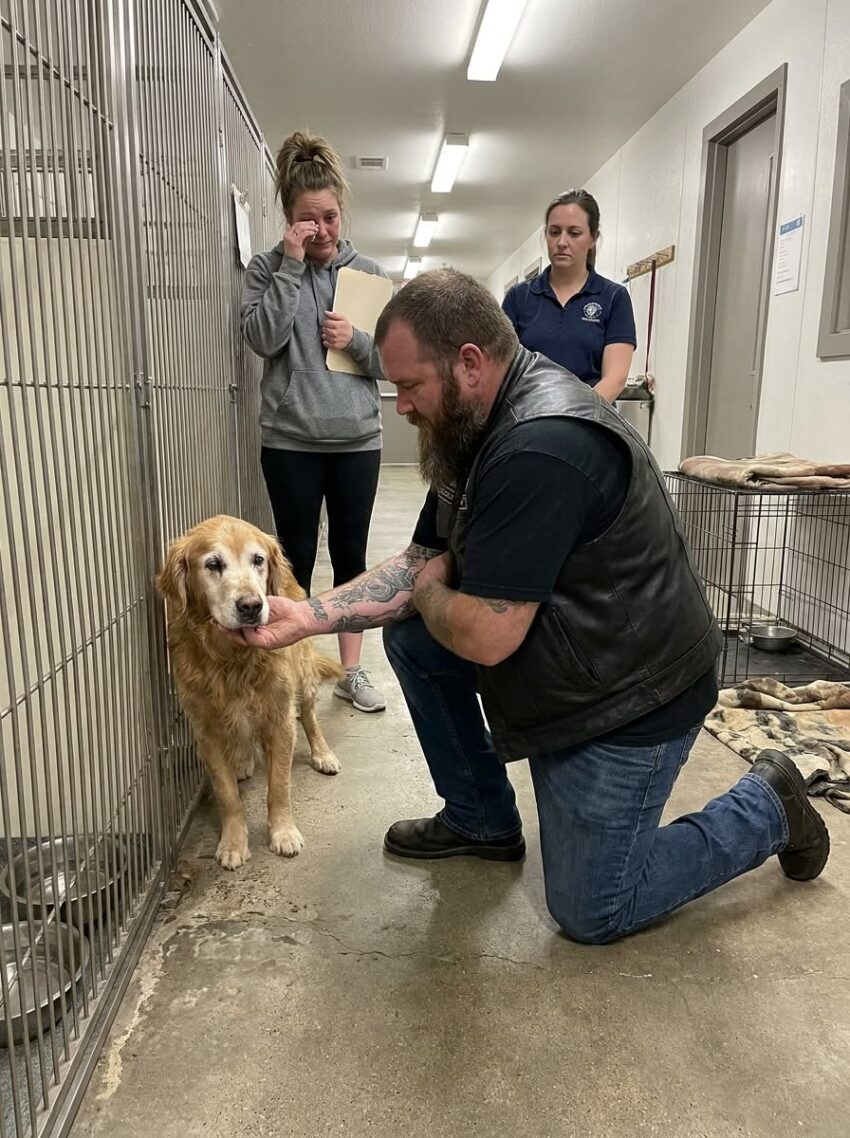
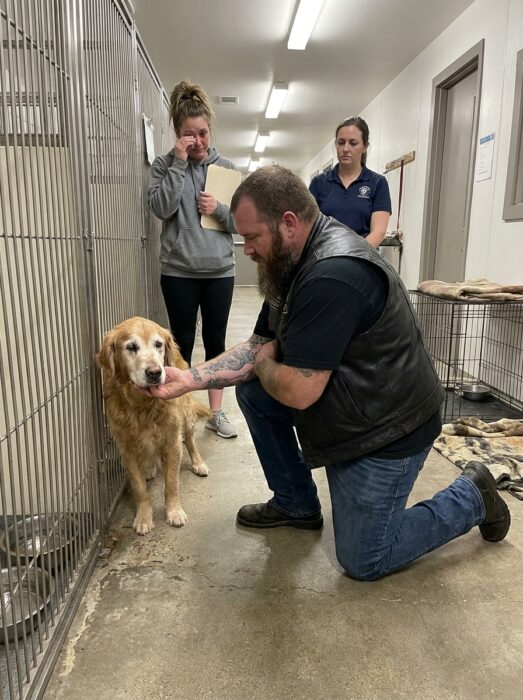
Halfway down the hallway, he stopped, tired.
Wade did not pull.
He crouched beside him, one knee on the floor, ignoring the ache in his own back.
“No rush, buddy,” he said. “We’ve got all the time they gave us.”
It turned out they had more.
But nobody knew that yet.
PART 4, THE TWO BEST WEEKS
Wade had planned for two weeks.
That was the strange beauty of it.
He did not bring Rusty home with big fantasies about beating cancer, confusing denial with love, or pretending an old body could be talked into youth. He brought him home with soft beds, boiled chicken, medicine alarms, towels by the door, rugs on the floor so old paws would not slip, and a promise that whatever time remained would not be spent under fluorescent lights.
The first night, Rusty was restless.
He paced as much as his weak hips allowed. He drank water, forgot where the bowl was, then found it again. He stood in the hallway staring at shadows. Wade slept on the couch because Rusty could not climb the bed, and because the thought of the old dog waking alone in a strange house was more than he could stand.
At 2:13 a.m., Rusty whimpered.
Wade opened his eyes immediately.
“I’m here.”
Rusty came to the couch, slow and uncertain. Wade lowered one hand. The dog pressed his head into it, then exhaled.
That sound did something to the room.
For the first time in six months, Wade’s house had another heartbeat in it.
The next days became simple in a way grief had not allowed Wade’s life to be. Wake up. Help Rusty outside. Give medicine. Warm soft food. Sit on the porch. Brush the old coat gently. Drive to the park if the weather was good. Let Rusty sniff one tree for as long as he wanted because, as Wade told Linda Marlow, “When you’re fifteen, you’ve earned the right to read the whole newspaper.”
Neighbors began to notice.
Wade bought a red wagon from a yard sale and lined it with Rebecca’s old quilt. When Rusty got too tired to walk, Wade lifted him with both arms as carefully as if he were carrying glass and placed him in the wagon. Then the 6-foot-5 biker pulled him around the block, leather vest, boots, gray beard, tattoos, old golden retriever riding like a retired king.
Children loved it.
Adults tried not to stare.
Rusty did not care either way.
He sat with his white muzzle lifted into the wind, ears moving slightly, cloudy eyes half-closed. Sometimes Wade stopped at the corner store and bought a small vanilla ice cream cup, just enough for Rusty to taste with the vet’s permission. Sometimes they sat by the pond and watched geese argue. Sometimes Wade talked to him about Rebecca because old dogs are excellent keepers of names.
“You would’ve liked her,” Wade told him one afternoon.
Rusty rested his chin on the wagon edge.
“She would’ve said you’re too skinny and then fed you better than me.”
Rusty blinked.
Wade smiled for the first time without feeling guilty.
At the end of two weeks, Wade woke up expecting the worst because hope had become something he distrusted.
Rusty was still there.
Not cured.
Not young.
Not suddenly strong.
But there.
He ate breakfast. He wagged his tail. He followed Wade to the porch, slowly, stubbornly, alive.
Wade called Emily at the shelter.
“I think he missed his deadline,” he said.
Emily laughed through tears.
“Good.”
The vet was cautious.
Dr. Samuel Reed, a fifty-six-year-old white American veterinarian with gray hair, kind eyes, and the careful voice of a man who had delivered both miracles and hard endings, examined Rusty and shook his head slightly.
“I would not call this recovery,” he said. “But his weight is up. His heart sounds better than expected. His pain seems controlled. Whatever you are doing, keep doing it.”
Wade looked at Rusty.
Rusty looked back, tail thumping once.
So they kept doing it.
PART 5, THE DOG WHO STAYED
The third week became a month.
The month became two.
By the third month, Rusty had become a small local legend, though Wade hated that phrase. He was simply an old dog who rode in a red wagon, wore a blue bandana, napped on the porch, and had somehow convinced a grieving biker to keep the back door open when the weather was nice.
Emily visited once with Mara from the shelter.
They found Wade sitting on the porch steps while Rusty slept beside him on a thick orthopedic bed. There was a bowl of water nearby, a folded towel, a brush, medicine bottles arranged on a tray, and a small framed photo of Rebecca tucked on the porch table where the morning sun touched it.
Emily knelt beside Rusty.
“Hey, old man.”
Rusty opened one eye, recognized her, and thumped his tail.
Emily covered her mouth.
Mara looked away toward the yard, blinking hard.
Wade pretended not to notice because he understood dignity in both people and animals.
“He’s bossy now,” he said.
Emily wiped her cheek. “Rusty?”
“Refuses breakfast unless it’s warmed. Won’t go around the block unless we stop at Mrs. Marlow’s. Barks once if I forget his porch blanket.”
Rusty, who had not barked at the shelter for weeks, opened his mouth and released one rusty little woof, as if confirming the accusation.
Mara laughed.
That was when Wade realized something he had not wanted to admit.
Rusty had not only survived the first two weeks.
He had moved in.
Not just into the house.
Into Wade’s routine, his grief, his silences, his mornings, his reasons to stand up. The old dog needed him, yes, but need was no longer a burden. It was a rope thrown across the emptiness.
Every morning, Wade had to get up because Rusty needed medicine.
Every afternoon, he had to go outside because Rusty wanted sun.
Every evening, he had to cook something because Rusty needed soft food, and once the kitchen smelled warm again, Wade sometimes fed himself too.
Linda Marlow noticed that before Wade did.
One Wednesday, she brought soup and found him washing dishes while Rusty watched from the rug.
“You look better,” she said.
Wade grunted.
“That dog’s expensive.”
“I did not say richer. I said better.”
He dried a bowl.
Linda looked at Rusty, then at the photo of Rebecca on the shelf.
“She would be glad.”
Wade’s hands stopped moving.
“I know.”
That was all he said, but his voice changed on the words.
The fourth month, Dr. Reed took new blood work and repeated the exam. He read the chart twice.
“I can’t explain this the way people want me to explain it,” he told Wade. “Cancer is still there. Age is still there. But he is stronger than he was. His body is responding to care, food, comfort, pain control, reduced stress, all of it.”
Wade scratched Rusty behind one ear.
“So love is medical now?”
Dr. Reed smiled gently.
“I would not write that on a chart.”
Rusty leaned into Wade’s leg.
“But I would not argue with it either.”
PART 6, THE MONTH REBECCA WOULD HAVE LOVED
By the sixth month, Wade stopped counting Rusty’s life in borrowed days and started counting it in memories they had actually made.
There was the morning Rusty stole half a biscuit from the porch table and looked so proud that Wade did not have the heart to scold him. There was the afternoon the Iron Hollow Riders came over for a cookout, and forty rough-looking bikers took turns greeting an old golden retriever like he was a retired president. There was the day Rusty fell asleep with his head on Wade’s boot during a thunderstorm, and Wade realized he had not felt useless in a long time.
There was also Rebecca’s birthday.
Wade dreaded it for weeks.
The first birthday after her death had been unbearable. The second important dates were not easier, only more familiar in their cruelty. He planned to stay home, avoid people, and maybe ride until the road blurred. But Rusty woke that morning with unusual energy. He ate breakfast. He wagged his tail. He stood by the door as if he had somewhere in mind.
Wade stared at him.
“You got plans?”
Rusty wagged again.
Wade did not know why he did it, but he packed the red wagon, Rebecca’s blue blanket, a thermos of coffee, two bottles of water, Rusty’s medicine, and the old bag of senior dog treats that had started everything. Then he drove to Lake Mercer Park, where Rebecca used to walk their dogs in the fall.
The trees were beginning to turn.
Gold leaves moved across the path.
Rusty rode in the wagon for most of it, but near the lake, he insisted on getting out. Wade lifted him gently. The old dog stood on shaky legs, sniffed the air, then walked six slow steps toward a bench under a maple tree.
It was Rebecca’s favorite bench.
Wade sat down hard.
Rusty leaned against his leg.
For a while, the world was quiet.
Then Wade took out Rebecca’s photo, the one he carried in his vest pocket, and set it beside him on the bench.
“This is him,” he said softly, as if introducing them. “This is Rusty.”
The dog rested his chin on Wade’s knee.
Wade laughed once, broken and real.
“She would’ve spoiled you rotten.”
A woman walking by slowed down. She was older, maybe seventy, with a small terrier and a kind face. She looked at Wade, the photo, the old dog, and the red wagon, then seemed to understand enough not to ask too much.
“Beautiful dog,” she said.
Wade nodded.
“Yes, ma’am.”
“Yours?”
He looked at Rusty.
Then at Rebecca’s picture.
Then back at the lake.
“Yeah,” he said. “We belong to each other.”
That was the first time he said it out loud.
Not that he had adopted Rusty.
Not that Rusty was Rebecca’s kind of dog.
Not that he was giving the old dog a good ending.
They belonged to each other.
When they got home, Wade found a note tucked into his mailbox from Emily at the shelter. It said, “Six months. He has lived six months loved. Whatever happens next, thank you.”
Wade taped the note to the refrigerator beside Rebecca’s grocery list.
Rusty lived two more months after that.
PART 7, THE GOODBYE THAT WAS NOT EMPTY
Rusty’s last morning came in winter.
It was quiet, gray, and soft, the kind of morning when sound seems folded inside the snow. Wade knew before the vet confirmed it. People who love old animals learn the language of small changes. Rusty did not want breakfast. He did not want the porch. He rested his head on Wade’s boot and looked up with tired, peaceful eyes that no longer asked for more time.
Wade called Dr. Reed.
Then he called Emily.
Then, after staring at the phone for a long minute, he called Linda Marlow.
By noon, the living room was warm. Rebecca’s quilt was spread on the floor. Rusty lay on it with his head in Wade’s lap. Emily came from the shelter and sat near his paws. Linda brought soup no one ate. Dr. Reed arrived with his black bag and the gentleness of a man who understood that the final act of care still hurts like betrayal, even when it is mercy.
Wade had faced war, death, surgery rooms, funeral homes, and the long hallway of grief after Rebecca. Still, his hands shook when he signed the paperwork.
Dr. Reed touched his shoulder.
“You gave him eight months.”
Wade looked down at Rusty.
“No,” he said. “He gave me eight months.”
Emily started crying then.
Rusty’s tail moved once when Wade said his name.
The end was peaceful.
That matters.
It does not make it painless, but it matters.
Wade held him through the last breath, one hand on the old dog’s chest, the other buried in the faded golden fur behind his ears. He whispered everything he needed Rusty to carry with him, that he was good, that he was loved, that Rebecca would know him, that he had done his job better than any dog should have had to.
Afterward, the house went quiet again.
But it was not the same quiet.
That is hard to explain unless you have lived through grief twice and discovered the second loss does not erase what the first healing gave you. Rusty’s absence hurt, but it did not leave Wade where Rebecca’s death had left him. The old dog had changed the rooms. He had brought back footsteps, bowls, blankets, porch mornings, park walks, neighbors, laughter, responsibility, and the strange courage to love something temporary.
A week later, Wade went back to Willow Creek Animal Shelter.
Emily saw him come through the door and froze.
He looked terrible, tired, red-eyed, unshaven, but standing.
“I’m not ready,” he said.
Emily nodded carefully.
“That’s okay.”
He handed her Rusty’s blue bandana, washed and folded.
“I want you to keep this somewhere.”
She took it with both hands.
Then Wade added, “And when the next old one has nobody, call me.”
Emily stared at him.
“Are you sure?”
Wade looked down the hallway toward the senior kennels, where dogs barked, paced, slept, waited, hoped, and tried not to disappear before someone noticed them.
“No,” he said honestly. “But Rusty wasn’t sure either.”
Over the next year, Wade did not become some perfect hero who never hurt again. He still missed Rebecca. He still missed Rusty. He still had evenings when the house felt too large and mornings when grief sat beside him at the kitchen table like an old enemy. But now there was a framed photo on the wall of a huge biker pulling a red wagon with a fifteen-year-old golden retriever sitting inside, ears lifted in the wind, looking like an old king on parade.
Under the photo, Wade placed Emily’s note.
He lived six months loved.
Then he added his own line beneath it.
Eight months, actually. And he loved me back.
People always say Wade saved Rusty because that is the easy version. A grieving biker walked into a shelter, chose the oldest, sickest dog, and gave him a soft place to die. That version is true, but it is not the whole truth. Rusty saved Wade too, not by curing grief, not by replacing Rebecca, not by doing anything dramatic enough for a movie poster, but by needing breakfast, sunlight, medicine, slow walks, porch blankets, and a man who had forgotten what it felt like to be needed without being pitied.
Wade once told me, “I adopted him so he wouldn’t die alone. Turns out he stayed so I wouldn’t live alone.”
That is the story.
Not a miracle in the way people use that word when they want life to become fair.
Rusty still got old. He still got sick. Wade still had to say goodbye.
But two weeks became eight months.
A cage became a porch.
A dying dog became family.
And a man who thought he had nothing left to give found out that love does not disappear when the person you built your life with is gone. Sometimes it waits in an unopened bag of senior dog treats. Sometimes it looks up from the last kennel in a shelter. Sometimes it has a white muzzle, cloudy eyes, weak hips, and just enough time left to save the person who came to save it.
Follow the page for more unforgettable biker stories about lonely dogs, grieving hearts, and the rough-looking people who prove that love can still arrive late and change everything.