The Boy Who Stopped Hiding
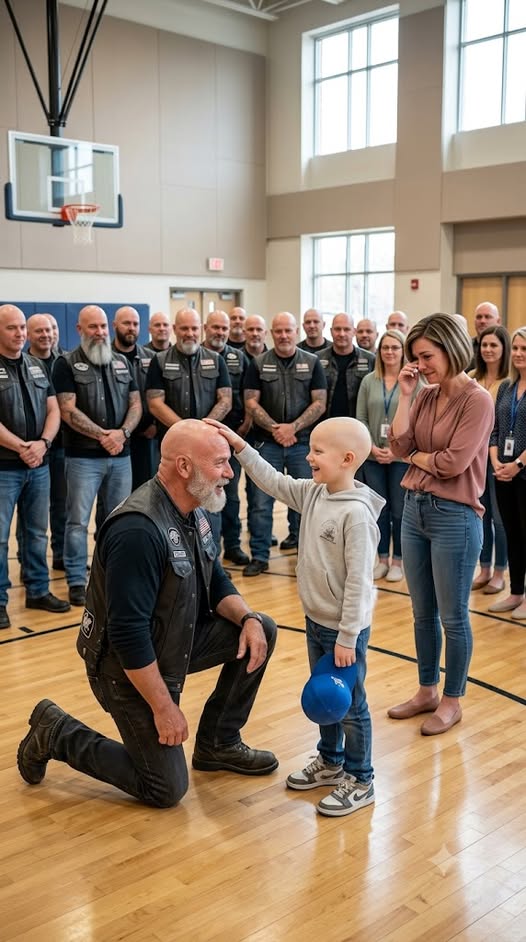
Nine-year-old Miles Warren stood frozen in the middle of the elementary school gym in Grand Rapids, Michigan, staring at a group of motorcycle riders he had never seen before.
There were thirty-two of them.
Big men. Broad shoulders. Leather vests. Heavy boots. Gray beards. Tattooed arms. The kind of people most children would step away from without knowing why.
But what Miles noticed first was not their size.
It was their heads.
Every single one of them had been shaved.
Miles reached for the navy baseball cap he had worn every day for nearly five months. His fingers curled around the brim. For a moment, he looked at his mother as if asking permission to disappear.
My name is Laura Warren, and that little boy under the basketball hoop was my son.
Five months earlier, Miles had started treatment for leukemia.
Before that, he had thick light-brown hair that never stayed neat. He used to shake it out of his eyes before kicking a soccer ball, and he hated haircuts because he said they made him look too serious.
Then the medicine started doing what the doctors said it might do.
First, his hair appeared on his pillow.
Then it came off in his hands.
One night, Miles stood in front of the bathroom mirror and whispered, “Mom, can you help me make it look less scary?”
I shaved the rest while trying not to let my hands tremble.
After that, the cap became part of him.
He wore it at breakfast. He wore it in the car. He wore it at school. Sometimes he even slept with it pulled low over his forehead.
The school allowed it because of his condition.
But permission could not stop every stare.
Most children were kind. Some asked questions softly. Some carried his books when he felt tired.
But a few were not.
One boy called him “the kid with no hair.” Another asked if his head was supposed to look like that. Miles pretended not to hear them, but each word followed him home.
Then one windy afternoon, his cap blew off during recess.
A fifth-grade boy grabbed it before Miles could reach it. He lifted it high above his head and laughed.
“Hey, somebody lost his hiding place!”
Miles stood there with both hands covering his bare scalp while other children stared.
That evening, he did not want dinner.
He sat on his bed and said, “I don’t look like myself anymore.”
His teacher, Mrs. Calloway, wrote a short post asking parents to teach their children more kindness around illness and differences. She did not use Miles’s full name. She did not share his picture.
But someone sent the post to a local motorcycle club called the Riverbend Riders.
Their president was Owen “Hawk” Mercer, a sixty-one-year-old biker with a white beard, wide shoulders, and a quiet voice that somehow made people listen.
Hawk read the post during a club meeting.
Then he placed a pair of clippers on the table.
“This little boy thinks being bald makes him alone,” Hawk said. “I’m wondering how many of us are willing to prove him wrong.”
The room became silent.
Then one rider stood.
Then another.
Then another.
Some had worn long hair for thirty years. One rider had a silver ponytail he had not cut since his wife passed away. Another joked that his head was shaped like a potato and the world was not ready for it.
But every one of them sat in the chair.
Three days later, the principal called me and asked if Miles could attend a small school assembly.
I did not tell Miles what was waiting.
When we walked into the gym, thirty-two motorcycles were parked outside in a perfect row.
Inside, the riders stood beneath the basketball hoop in a wide half-circle.
Miles stopped so suddenly I almost bumped into him.
Hawk stepped forward and slowly lowered himself onto one knee.
He removed his black cap, showing his freshly shaved head.
Then he smiled at Miles.
“We heard bald heads were getting laughed at around here,” he said. “So we brought thirty-two more.”
Miles did not move.
Hawk pointed behind him.
“If anybody laughs at your head now, they are laughing at all of ours too.”
The gym was completely quiet.
Miles’s small hand went to his cap. He held it for a long moment.
Then, very slowly, he took it off.
For the first time in months, my son stood in school without hiding.
His other hand immediately rose to cover his head, but Hawk gently shook his own head.
“No need, buddy,” he said. “You fit right in with us.”
Miles looked at the riders.
Then he noticed a tiny strip of gray hair above Hawk’s left ear.
He pointed at it.
“You missed a spot.”
Hawk touched the patch and frowned.
“That is what happens when you let a man named Moose handle sharp equipment.”
Miles laughed.
Not a polite laugh.
Not the small smile he gave nurses so they would not worry.
A real laugh.
The kind that came from his belly and made his shoulders shake.
I covered my mouth because I had not heard that sound in months.
A few of the riders turned away and wiped their eyes.
After the assembly, Miles sat beside Hawk on the lowest bleacher.
He touched Hawk’s shaved head like he still could not believe it was real.
Then he asked, “Why would you do that for me? You don’t even know me.”
Hawk looked down at the floor for a long time.
Then he reached into the inside pocket of his vest and pulled out an old photograph.
In the picture was a little boy with a thin face, bright eyes, and a scarf wrapped around his head.